ARTICLES
Category:
Paid Ads Strategy
Artificial intelligence is rapidly transforming the way people discover products online. Instead of opening a search engine, browsing multiple websites, and comparing dozens of tabs, consumers are increasingly turning to conversational AI platforms for personalized shopping advice.
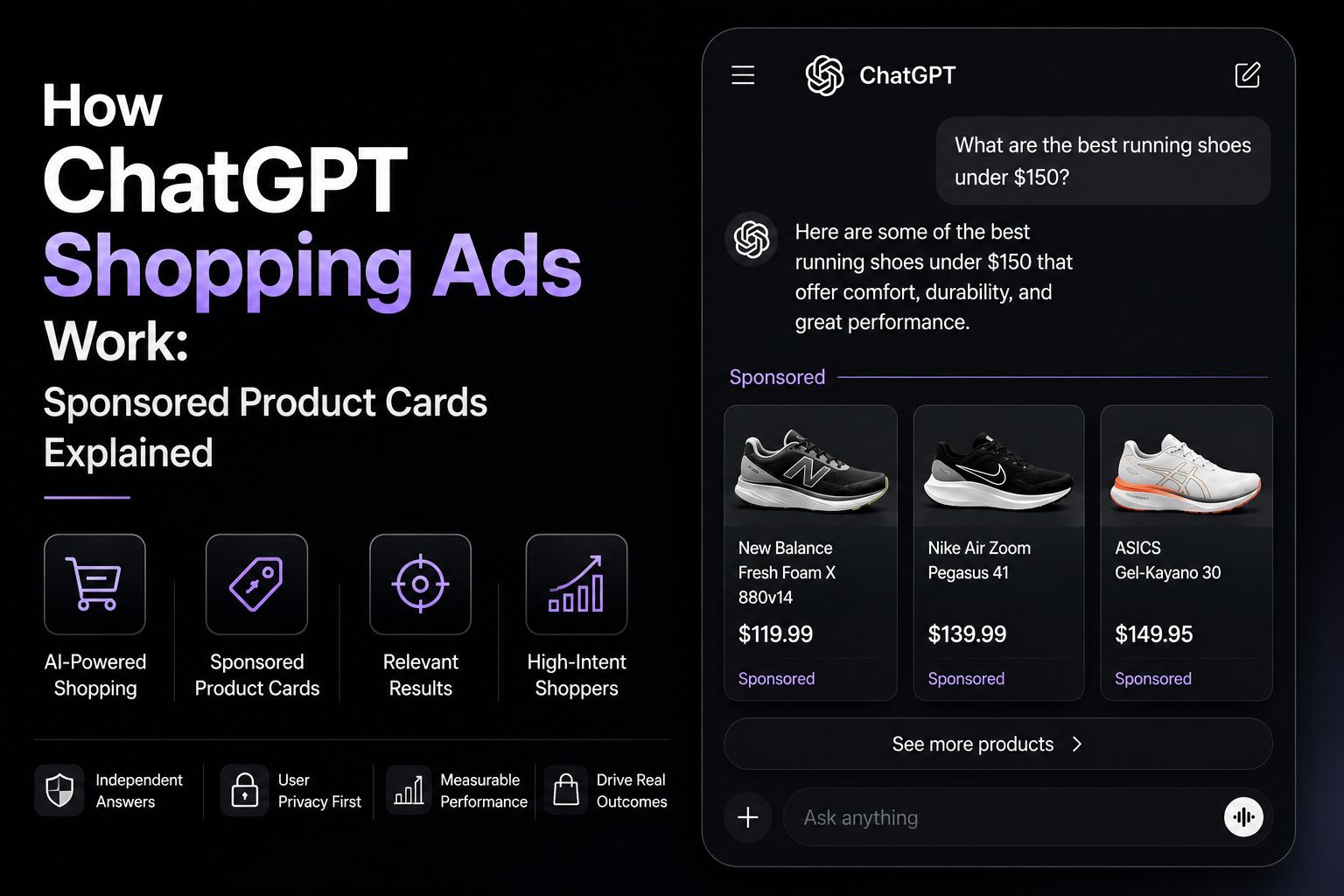
One of the biggest developments in this space is the introduction of ChatGPT Shopping Ads, a new advertising format that allows brands to showcase products directly within shopping-related conversations. Through Sponsored Product Cards, businesses can place relevant products in front of high-intent users at the exact moment they're researching potential purchases.
For ecommerce brands, D2C businesses, and retailers, this represents a significant shift in digital advertising. Product discovery is moving beyond traditional search engines and social feeds into AI-powered conversations.
In this guide, we'll explain how ChatGPT Shopping Ads work, how Sponsored Product Cards are displayed, how advertisers participate, and what brands should do to prepare for the future of conversational commerce.
Key takeaways
ChatGPT Shopping Ads operate independently from organic AI recommendations.
Sponsored Product Cards are clearly labeled and visually separate from generated responses.
Brands participate through product feeds, relevance-based auctions, and performance tracking systems.
Conversational commerce introduces a new form of high-intent product discovery.
Early optimization may help ecommerce brands gain an advantage as AI shopping continues to evolve.
What Are ChatGPT Shopping Ads and Why Do They Matter?
As AI becomes part of everyday decision-making, consumers are beginning to use ChatGPT for more than answers and research. Many users now ask questions like:
What are the best running shoes under $150?
Which luxury handbag is worth buying in 2026?
What's the best skincare routine for sensitive skin?
Which laptop should I buy for video editing?
These conversations create opportunities for product discovery.
The Evolution of Shopping Inside AI Conversations
Traditional ecommerce journeys usually follow a predictable pattern:
Search → Browse → Compare → Purchase
With AI-powered shopping, the process becomes:
Ask → Receive Recommendations → Evaluate Options → Purchase
Instead of searching through multiple pages, users can receive contextual recommendations instantly.
This is where AI Shopping Ads enter the picture.
Rather than interrupting users with banner ads or forcing products into social feeds, ChatGPT introduces products when they're relevant to an active shopping conversation.
Understanding Sponsored Product Cards
Sponsored Product Cards are advertisements that appear separately from ChatGPT's generated responses.
These cards may include:
Product image
Product name
Pricing information
Retailer information
Direct product links
A visible "Sponsored" label
The format is designed to help users explore products while maintaining transparency about which placements are paid advertisements.
Importantly, these cards are visually distinct from ChatGPT's organic responses.
Where Shopping Ads in ChatGPT Appear
Sponsored placements generally appear in conversations involving:
Product Research
When users seek recommendations for a product category.
Example:
"What's the best smartwatch for fitness tracking?"
Product Comparisons
When consumers compare multiple products.
Example:
"Apple Watch vs Garmin: Which is better?"
Purchase-Oriented Searches
When users express buying intent.
Example:
"Recommend affordable luxury watches under $500."
Category Exploration
When users are still evaluating options.
Example:
"What are the best sustainable fashion brands?"
In these scenarios, Sponsored Product Cards may appear beneath the AI-generated response.
Why Brands Are Paying Attention
The significance of ChatGPT Shopping Ads lies in intent.
Unlike social media users who may not be actively shopping, ChatGPT users often arrive with a specific question and a purchasing goal.
This creates several advantages:
Higher purchase intent
Reduced customer acquisition friction
More contextual targeting
Stronger relevance between product and consumer needs
For ecommerce brands, this means reaching potential buyers closer to the moment of decision.
Before exploring advertising opportunities, however, it's important to understand exactly how ChatGPT Shopping Ads work behind the scenes.
How ChatGPT Shopping Ads Work Behind the Scenes
One of the most common misconceptions about ChatGPT Ads is that advertisers can influence recommendations.
That's not how the system operates.
Contextual Matching Drives Ad Relevance
The advertising system evaluates the context of a user's conversation and identifies relevant products from participating advertisers.
For example, if a user asks:
"What are the best hiking boots under $150?"
ChatGPT may generate an organic answer discussing various product features and buying considerations.
Separately, the advertising system may display Sponsored Product Cards featuring hiking boots from advertisers whose products match the query.
This contextual matching process is designed to improve relevance while preserving the integrity of the AI's response.
The Difference Between Organic Recommendations and Sponsored Placements
Understanding this distinction is critical.
Organic Recommendations
These are generated by ChatGPT's language model.
The AI evaluates the conversation and provides recommendations based on available information and context.
Sponsored Product Cards
These are advertisements delivered through a separate advertising system.
Advertisers pay for visibility through the ad platform, but they do not directly influence ChatGPT's generated answers.
This separation helps maintain trust while creating monetization opportunities for the platform.
Understanding OpenAI's Answer Independence Model
A key principle behind ChatGPT Shopping Ads is often referred to as answer independence.
This means:
Advertising systems operate separately from the AI model.
Advertisers cannot purchase favorable recommendations.
Organic answers remain independent.
Sponsored content is clearly labeled.
For users, this distinction is important because it ensures that recommendations remain trustworthy.
For brands, it creates a transparent advertising environment where visibility is earned through relevance and bidding rather than influence over responses.
What Users Actually See
When Sponsored Product Cards appear, they are placed in a dedicated advertising area.
Users typically see:
Product image
Product title
Merchant information
Pricing
Sponsored disclosure
Clicking a card redirects the user directly to the advertiser's product page or website.
The goal is to provide a seamless path from product discovery to purchase without disrupting the conversational experience.
A New Layer of Product Discovery
Rather than replacing organic recommendations, ChatGPT Sponsored Listings act as an additional discovery layer.
Users receive:
AI-generated guidance
Relevant sponsored products
Direct access to purchase opportunities
This creates a shopping experience that feels more natural than traditional search advertising while still providing brands with measurable visibility.
Who Sees ChatGPT Shopping Ads and When Are They Displayed?
Not every ChatGPT user currently sees advertisements.
Understanding audience eligibility is important for both consumers and advertisers.
Eligible Users and Ad Visibility
At present, ads are primarily shown to users on eligible ad-supported plans.
These typically include:
Free users
Go plan users (where applicable)
Users on premium plans generally do not see advertisements, including:
Plus
Pro
Enterprise
Ad-free plan options
This approach allows OpenAI to balance monetization with premium subscription experiences.
Conversation Types Most Likely to Trigger Ads
Ads do not appear in every conversation.
They are most likely to be shown when commercial intent is detected.
Common triggers include:
Product Recommendations
Users actively seeking product suggestions.
Shopping Comparisons
Evaluating multiple options before purchasing.
Brand Research
Exploring brands within a category.
Purchase-Oriented Questions
Questions that indicate buying intent.
The stronger the shopping context, the more likely Sponsored Product Cards may appear.
Factors That Influence Ad Delivery
Several factors can influence whether ads are shown.
These may include:
Query relevance
Product catalog availability
Advertiser bids
User intent signals
Product category suitability
The goal is to ensure users see products aligned with the conversation rather than generic advertising.
Privacy Considerations for Users
One of the most frequently asked questions about ChatGPT Ecommerce Advertising concerns privacy.
According to OpenAI's stated approach:
Conversations remain private from advertisers.
Advertisers do not receive chat transcripts.
User data is not sold to advertisers.
Ads operate independently from private conversations.
This distinction helps maintain user trust while supporting relevant advertising experiences.
How Brands Advertise Through ChatGPT Shopping Ads
For advertisers, the appeal of ChatGPT Shopping Ads is simple: reach consumers while they're actively researching products. Instead of interrupting users with irrelevant promotions, brands can place products directly into high-intent shopping conversations.
As conversational commerce grows, understanding the mechanics behind ChatGPT Ecommerce Advertising becomes increasingly important.
Product Feed Integration and Catalog Setup
Like Google Shopping and other product-based advertising systems, ChatGPT Shopping Ads rely on structured product data.
Brands typically connect their ecommerce catalog through:
Shopify integrations
Ecommerce platforms
Product feed management systems
Custom product feeds
The product feed acts as the foundation of the advertising system.
A typical feed contains:
Product titles
Product descriptions
Images
Pricing
Availability
Category information
Product URLs
The more complete and accurate the feed, the easier it becomes for the platform to match products to relevant conversations.
Why Product Feed Quality Matters
Many advertisers focus heavily on bidding strategies while overlooking feed quality.
However, conversational shopping environments rely heavily on product context.
For example, a vague product title like:
"Men's Shoe Model X12"
provides significantly less context than:
"Men's Waterproof Hiking Boots for Trail Running and Outdoor Adventures"
The latter gives the system more information for matching products to relevant shopping conversations.
As AI-driven commerce evolves, product data optimization will likely become as important as traditional SEO.
Understanding the Auction and Bidding Model
Once products are available within the system, advertisers compete for visibility through an auction-based model.
How the Auction Works
ChatGPT Shopping Ads reportedly use a relevance-weighted auction structure.
This means placement is not determined solely by budget.
The system evaluates:
Product relevance
User intent
Bid competitiveness
Product-category alignment
As a result, advertisers with highly relevant products may outperform competitors with larger budgets.
CPC vs CPM Campaign Models
Brands may have different campaign objectives.
Common optimization models include:
Cost Per Click (CPC)
Advertisers pay when users click on a Sponsored Product Card.
Best suited for:
Direct-response campaigns
Ecommerce sales
Lead generation
Product launches
Cost Per Thousand Impressions (CPM)
Advertisers pay for visibility.
Best suited for:
Brand awareness
Product exposure
New market entry
Category leadership
Choosing the right model depends on business goals and measurement priorities.
What Costs Can Brands Expect?
As with any emerging advertising channel, pricing evolves over time.
Factors influencing costs include:
Competition
Product category
Audience demand
Seasonal trends
Query intent
Because AI commerce is still developing, advertisers who enter early may benefit from lower competition compared to mature platforms.
Tracking Performance and Attribution
Advertising budgets require accountability.
Fortunately, ChatGPT Ads support many familiar performance measurement approaches.
Core Metrics Brands Should Monitor
Click-Through Rate (CTR)
Measures how often users click on Sponsored Product Cards after viewing them.
A strong CTR generally indicates:
Relevant targeting
Effective product positioning
Strong user interest
Impressions
Tracks how often ads are displayed.
Useful for measuring:
Reach
Visibility
Brand exposure
Cost Per Click (CPC)
Helps evaluate efficiency and competitiveness.
Return on Ad Spend (ROAS)
Measures revenue generated relative to advertising investment.
Conversion Rate
Tracks how effectively traffic turns into customers.
Using UTM Parameters for Better Attribution
Many ecommerce teams already use:
Google Analytics 4
Triple Whale
Northbeam
Shopify Analytics
Adding UTM parameters enables deeper tracking of:
Traffic sources
Revenue contribution
Customer journeys
Assisted conversions
This helps brands understand how ChatGPT Shopping Ads contribute to overall performance.
ChatGPT Shopping Ads vs Traditional Search and Shopping Advertising
Whenever a new advertising channel emerges, marketers inevitably compare it to existing platforms.
The comparison between ChatGPT Shopping Ads and Google Shopping Ads is particularly relevant.
ChatGPT Ads vs Google Shopping Ads
Although both help consumers discover products, the user experience differs significantly.
Google Shopping
Users typically:
Enter keywords
Browse listings
Compare products manually
Visit multiple websites
ChatGPT Shopping
Users:
Ask conversational questions
Receive contextual guidance
Explore recommendations
Discover products naturally within the conversation
The difference may seem subtle, but it fundamentally changes how consumers interact with products.
Instead of searching, users are discussing.
Instead of browsing, users are receiving personalized assistance.
ChatGPT Ecommerce Advertising vs Social Commerce
Social platforms like Instagram and TikTok are highly effective for discovery.
However, users are often in entertainment mode rather than shopping mode.
Social Commerce Intent
Typical user behavior:
Passive scrolling
Content consumption
Brand discovery
Impulse purchases
Conversational Commerce Intent
Typical user behavior:
Active research
Product comparison
Purchase evaluation
Decision-making
This distinction makes conversational commerce especially attractive for performance-focused advertisers.
When consumers ask questions, they're often much closer to a buying decision.
Advantages of AI-Powered Product Discovery
Several factors make AI shopping experiences unique.
Personalized Context
AI understands the broader conversation.
Instead of matching keywords alone, it evaluates intent.
Reduced Search Fatigue
Consumers no longer need to review countless pages of results.
Relevant information is presented immediately.
Faster Decision-Making
Users receive product insights and recommendations within a single interaction.
Higher Purchase Intent
Questions often reveal genuine buying interest.
This creates opportunities for brands to reach consumers during critical decision-making moments.
Potential Limitations Brands Should Consider
Despite the excitement, ChatGPT Shopping Ads remain an emerging channel.
Brands should evaluate realistic expectations.
Limited Historical Data
Compared with Google or Meta, there is less long-term performance data available.
Evolving Measurement Standards
Attribution methodologies will likely continue to mature.
Audience Scale
While growing rapidly, AI shopping audiences may still be smaller than established advertising ecosystems.
For most brands, ChatGPT should complement—not replace—existing acquisition channels.
How Ecommerce Brands Can Prepare for the Future of AI Shopping Ads
Whether or not your brand begins advertising immediately, preparation matters.
The businesses that benefit most from emerging channels are often those that optimize early.
Optimize Product Data for AI Discovery
Strong product data improves visibility.
Focus on:
Clear product titles
Detailed descriptions
Category accuracy
Attribute completeness
The more context available, the easier it becomes for AI systems to understand your products.
Improve Product Content Quality
AI-driven commerce increasingly rewards high-quality information.
Consider strengthening:
Product imagery
Product videos
Reviews
FAQs
Product specifications
Better content improves both paid and organic discoverability.
Build Visibility Beyond Paid Placements
Not every product recommendation is sponsored.
Brands should also invest in:
SEO
Structured data
Helpful content
Product education resources
This creates opportunities to appear in broader AI-powered discovery experiences.
Why Early Adoption May Create Competitive Advantage
History tends to repeat itself.
Brands that embraced:
Google Ads early
Facebook Ads early
TikTok Ads early
often benefited from lower competition and cheaper acquisition costs.
The same pattern may emerge with AI Shopping Ads.
The Growing Opportunity for D2C and Fashion Brands
Fashion, beauty, lifestyle, and D2C brands may be particularly well positioned to benefit from conversational commerce.
Consumers frequently ask AI systems questions such as:
What luxury handbag should I buy?
Which skincare brand is best for sensitive skin?
What are the top sustainable fashion brands?
Which running shoes are worth the investment?
These are precisely the types of conversations where product discovery happens.
However, success requires more than simply uploading a catalog.
Brands must combine:
Strong product feeds
High-quality creative assets
Effective landing pages
Conversion optimization
Consistent brand positioning
For fashion and lifestyle brands, the opportunity extends beyond advertising alone. The brands that present clear product information, compelling content, and a seamless shopping experience will be best positioned to win in AI-powered commerce.
Conclusion
ChatGPT Shopping Ads represent one of the most significant developments in digital advertising since the rise of search and social commerce.
By introducing Sponsored Product Cards directly within shopping-related conversations, ChatGPT creates a new pathway between product discovery and purchase.
Unlike traditional advertising channels, these placements appear within highly contextual interactions where users are actively seeking guidance and recommendations.
Featured Case Study


304 %
Scaled Revenue MoM


4x ROAS
consistently over 6 months


125 %
YoY Meta Spend Growth


304 %
Scaled Revenue MoM
OUR APPROACH
Turning Performance Data
Into Profit Clarity
1. Profit-First Measurement
We start where most growth strategies stop: profit. Campaigns, channels, and products are evaluated against margin, contribution, and cash flow—not surface metrics.
2. Marketing Connected to the P&L
Performance data only matters when it maps to financial reality. We align ad spend, customer acquisition, inventory, and lifecycle value into a single decision-making system.
3. Continuous Financial Optimization
Growth isn’t a one-time model. We monitor performance as conditions change—traffic mix, demand, costs—so decisions stay profitable as you scale.




Want to get similar results?
Our Impact,
By The Numbers
RELATED ARTICLES