ARTICLES
Category:
Ads, Creative, Content, and Branding
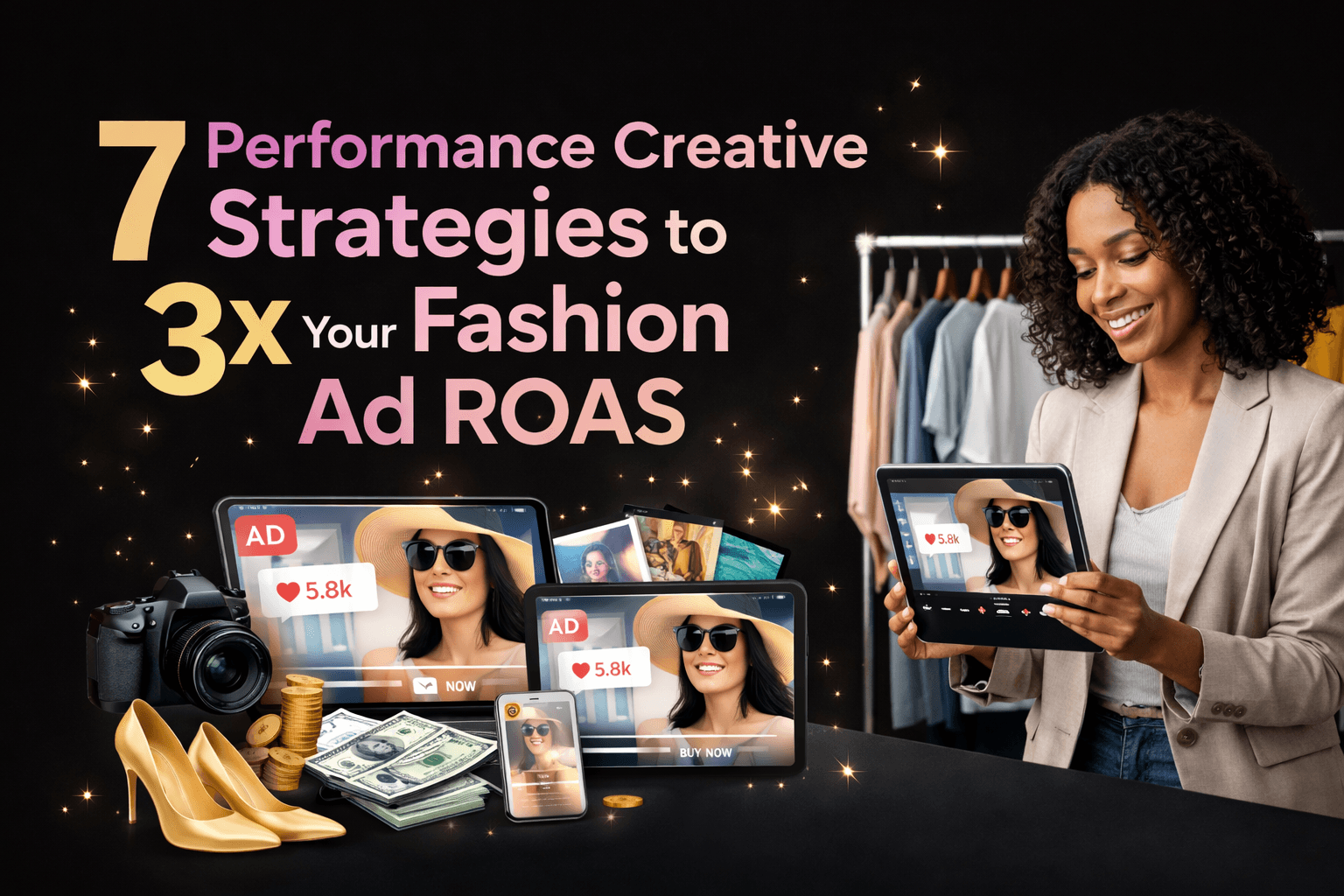
Aesthetics have always been the driving force behind fashion. But in today’s digital-first industry, smart design alone doesn’t guarantee results. Even while brands are investing more in paid advertising than ever before, many still find it difficult to grow financially. Even the most attractive campaigns may not convert, CPMs increase, and viewers scroll more quickly.
One thing that distinguishes aggressively growing brands from those that only advertise is performance creative for fashion brands.
Guessing which images seem good isn't what drives the growth of modern fashion. It involves developing innovative technologies designed to generate quantifiable income. When creative decisions are backed by data, testing, and customer psychology, advertising doesn't just impress, they sell.
These seven tried-and-true techniques can help you turn creativity into a reliable revenue generator and actually triple your fashion ad ROAS if your objective is to boost conversions and multiply profits.
What Is Performance Creative for Fashion Brands?
Launching a single, large-scale seasonal campaign and praying it succeeds is not performance-focused creative. It is a continuous process of testing, evaluating, and refining.
"Does this drive purchases?" is a better question to ask than "Does this look nice?"
This method combines design and analytics. Every call-to-action, image, and hook is tested in real time based on consumer behavior.
7 Performance Creative Strategies to 3x Your ROAS
Let's examine the precise strategies employed by high-growth brands.
1. Start With Data, Not Design
Many teams begin with mood boards or inspiration feeds. Numbers are the foundation of high-performing teams.
Before creating any new assets, examine:
Top-performing old ads
Rates of scroll stops
Effectiveness of hooks
Conversion patterns
Customer behavior and demographics
What really appeals to your audience is shown by these observations. For example, you might learn that lifestyle photographs beat studio photos, or that “try-on” videos drive higher engagement than static articles.
Evidence-based creative decision-making lowers uncertainty and boosts victory rates right away.
This is the cornerstone of a clever creative fashion advertising plan.
2. Build a Modular Creative System
Speed is important. You miss out on possibilities and waste money on stale creatives if it takes weeks to create new advertisements.
Rather, create interchangeable modular components:
Headlines
Hooks
Product images
Backgrounds
Offers
CTAs
Color variations
You can simply recombine components to create dozens of versions without having to start from scratch.
Benefits consist of:
Quicker testing
Lower production costs
Simpler platform scaling
Consistent brand identity
This approach allows teams to develop hundreds of Performance Creative Ads without overwhelming design resources.
3. Use UGC and Social Proof to Build Trust
Real individuals wearing items is what fashion customers want to see. Every time, authenticity triumphs over perfection.
Because they seem relatable and reliable, user-generated content (UGC), creator videos, and consumer testimonials routinely perform better than polished studio advertising.
Formats that work well include:
Try-ons hauls
Style advice
Before/after transformations
Honest reviews
Day-in-the-life clips
These resources immediately increase conversions by closing the trust gap and lowering buying hesitancy.
For many businesses, adding UGC alone can considerably boost Fashion Ads ROAS since shoppers feel more secure in their buying decisions.
4. Test Creatives Like a Scientist
Even the most seasoned marketers are unable to accurately forecast winners. Testing cannot be compromised.
High-performing teams follow a clear experimentation framework:
Test one variable at a time
Run several versions at once.
Get rid of underachievers fast.
Scale winners quickly
Continue to refresh
You might test different hooks such as:
"A new drop has just arrived."
"Back in stock"
"Styled 3 ways"
"Limited time 20% off"
Performance can be doubled with little adjustments.
Every creativity should be viewed as a hypothesis. The market tells you what works; it's your responsibility to pay attention and make adjustments.
5. Align Creative With the Funnel
Not every consumer is prepared to make a purchase right away. Results may suffer if hard-sell advertisements are seen too soon.
Instead, align your creatives to the consumer journey.
Top funnel (awareness):
Trend-driven visuals
Storytelling about a lifestyle
Overview of the brand
Middle funnel (consideration):
Advantages of the product
Reviews
Styling ideas
Bottom funnel (conversion):
Offers
Scarcity
Retargeting advertisements
Unambiguous CTAs
Because each advertisement aligns with the goal, this sequencing increases efficiency. When done well, it improves your entire fashion performance marketing ecosystem rather than depending on one-size-fits-all messaging.
6. Tailor Creatives to Each Platform
Every platform behaves differently.
Pinterest users explore differently from Instagram users, so what works on TikTok might not work on Meta.
Instead of repurposing the same asset everywhere, adjust for context:
TikTok: Raw, native, fast hooks
Instagram: Polished but scroll-stopping
Facebook: Benefit-driven storytelling
Pinterest: Aspirational, lifestyle-heavy
Performance is greatly impacted by platform-specific formatting, including aspect ratio, pace, captions, and length.
Instead of mindlessly replicating assets, treat each channel as its own creative environment.
Here's where Performance Creative for Fashion really shines: instead of opposing user behavior, it supports it.
7. Balance Brand Identity With Direct Response
Fashion is still emotional, but data is important.
Long-term loyalty weakens if advertisements seem excessively commercial or unrelated to your brand's narrative. The strongest creative balances performance with beauty.
Maintain consistency in these elements:
Color palette
Voice tone
Visual language
Philosophy of style
Narrative of the brand
You get the best of both worlds: high conversion and long-term equity, when consumers notice your brand right away and are still motivated to take action.
This balance is the essence of good Performance Marketing Creative.
Why Many Brands Partner With a Fashion Marketing Agency
Building these systems internally can be tough. Specialized knowledge and quickness are needed for creative production, testing, analytics, and scalability.
A committed fashion marketing agency offers:
Frameworks for structured testing
Quicker creative production
Data-backed decision making
Platform proficiency
Constant optimization
You get a repeatable growth engine in place of reactive efforts.
External experts frequently greatly speed results for brands that are serious about scaling successfully.
How Veicolo Drives Fashion Ad Performance Through Creative Innovation
At Veicolo, creativity is viewed as a revenue lever rather than as ornamentation.
As an expert in performance creative for fashion brands, the team blends design quality with rigorous testing and analytics to generate assets that consistently drive conversions. Instead of focusing on one-time campaigns, their strategy emphasizes creating scalable systems.
Veicolo stands out for its ability to combine media performance, production, and strategy all under one roof. This means that in order to increase return on ad expenditure, firms receive unique designs in addition to stunning graphics.
Their process normally includes:
Creative research driven by data
Production of modular assets
Collaborations between UGC and creators
Quick cycles of A/B testing
Constant optimization
Veicolo helps fashion companies expand more quickly while preserving a strong brand identity by coordinating creative with quantifiable results.
Conclusion: Turning Creativity Into Measurable ROAS Growth
Fashion advertising now focuses on quantifiable impact rather than just style.
Brands that approach creativity as adornment fail to scale. Companies that use creativity as a performance lever are consistently successful.
By embracing intelligent systems, authentic narrative, continuous testing, and platform-specific execution, you can transform your advertising into potent growth drivers and drastically enhance returns.
The future belongs to brands that mix artistry with data and that’s exactly what performance-focused creative makes feasible.
FAQs
1. What is performance creative for fashion brands?
Performance creative for fashion brands focuses on creating advertisements that particularly generate quantifiable outcomes like clicks, purchases, and ROAS. It ensures that every creative directly adds to revenue growth by combining data insights, testing, and improved visuals.
2. How can we better creatively improve fashion ad ROAS?
Stronger creative draws attention more quickly, conveys value effectively, and fosters trust. Increased user engagement and higher conversion rates result in lower acquisition costs and higher returns, which immediately boost campaign profitability.
3. How often should fashion brands refresh ad creatives?
Every one to two weeks, fashion brands should test and update their creatives. Frequent updates keep campaigns effective and scalable by preventing tiredness, sustaining engagement, and assisting in the discovery of new winning concepts before performance deteriorates.
4. What makes user-generated content (UGC) useful for fashion advertising?
UGC feels natural and relatable, which develops trust rapidly. Seeing actual consumers use items boosts purchase intent and decreases reluctance, frequently exceeding highly polished advertising in terms of engagement and conversions.
5. Should companies collaborate with a fashion marketing agency?
Access to knowledge, quicker creative development, and tested testing frameworks are all benefits of working with a professional firm. Fashion marketing agency helps brands scale effectively, avoid wasted cost, and deliver stronger long-term performance across channels.
Featured Case Study

304 %
Scaled Revenue MoM

4x ROAS
consistently over 6 months
125 %
YoY Meta Spend Growth

304 %
Scaled Revenue MoM
OUR APPROACH
Turning Performance Data
Into Profit Clarity
1. Profit-First Measurement
We start where most growth strategies stop: profit. Campaigns, channels, and products are evaluated against margin, contribution, and cash flow—not surface metrics.
2. Marketing Connected to the P&L
Performance data only matters when it maps to financial reality. We align ad spend, customer acquisition, inventory, and lifecycle value into a single decision-making system.
3. Continuous Financial Optimization
Growth isn’t a one-time model. We monitor performance as conditions change—traffic mix, demand, costs—so decisions stay profitable as you scale.



Want to get similar results?
Our Impact,
By The Numbers
RELATED ARTICLES