ARTICLES
Category:
Paid Ads Strategy
Fashion brands rarely struggle because they cannot find the CBO toggle or set an ad-set budget. The harder question is knowing when to give the platform more control and when to keep that control yourself.
That is why the CBO vs ABO debate matters.
A campaign structure that works for a fashion brand spending $3,000 per month may become restrictive at $50,000 per month. At the same time, a highly automated setup that performs well at scale can make testing unnecessarily messy for a smaller account. The right decision depends on your spend, conversion volume, creative maturity, margins, inventory, testing goals, and how much reliable data your account produces.
Instead of asking whether one structure is universally better, fashion brands should ask: What are we trying to learn, and how much control do we need at our current stage of growth?
This guide breaks that decision down by spend level.
Quick Answer
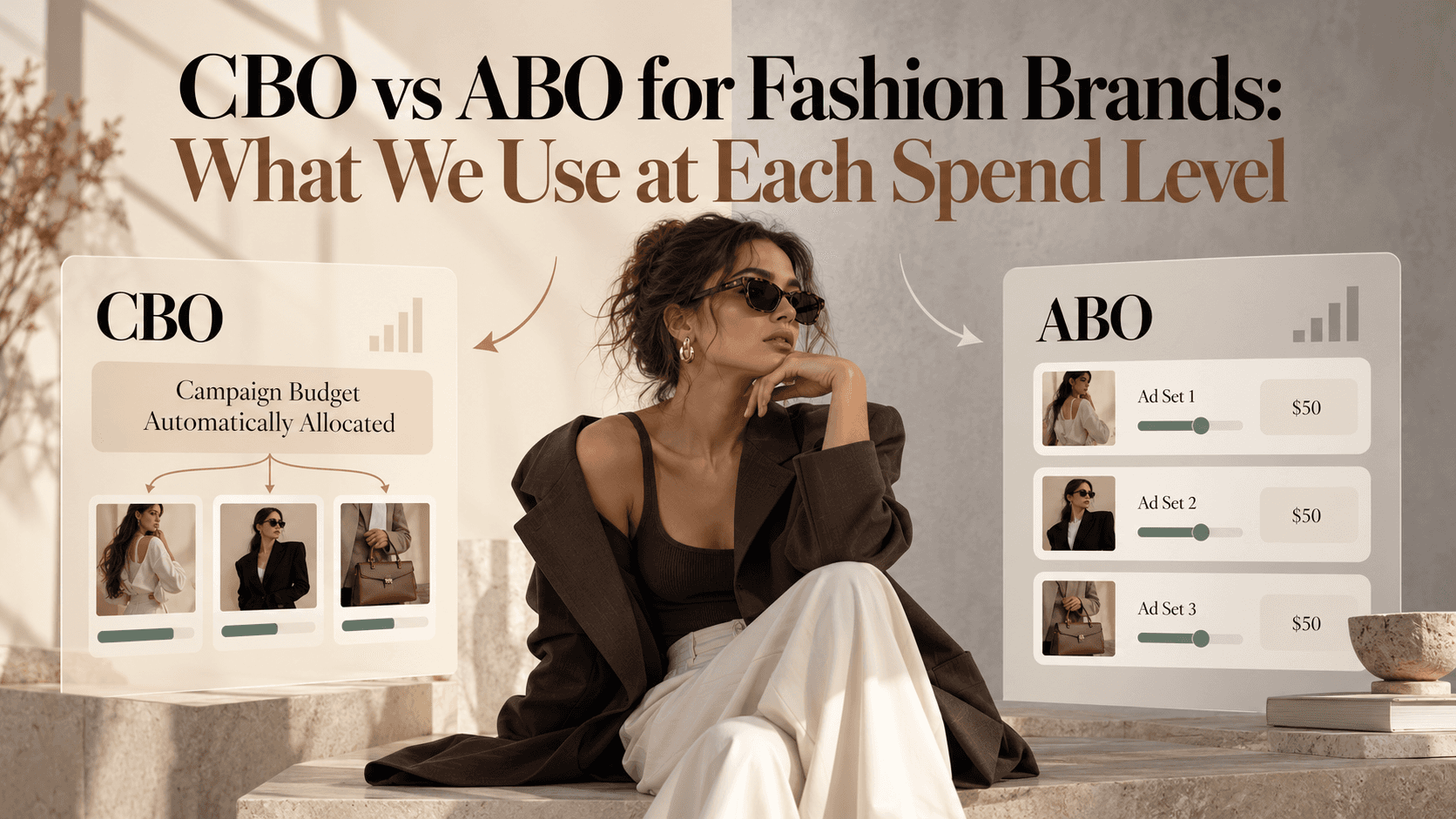
ABO (Ad Set Budget Optimization) gives you manual control over spending at the ad set level, while CBO (Campaign Budget Optimization, now called Advantage campaign budget) lets Meta's algorithm automatically distribute money across ad sets based on real-time performance
Should Fashion Brands Use CBO or ABO?
For most fashion brands, ABO is more useful when controlled testing matters, while CBO becomes more valuable when you already have proven variables and want the platform to distribute budget toward stronger opportunities.
A practical starting framework looks like this:
Under $5K/month: Favor ABO and controlled learning.
5K-15K/month: Use ABO for testing and selectively introduce CBO for winners.
15K- 50K/month: Move toward a hybrid model.
50K-100K/month: Lean more heavily on CBO and account consolidation.
100K-500K+/month: Build a scalable system combining automated allocation with dedicated testing.
The decision is not simply CBO vs ABO. It is really a question of control versus flexibility at each stage of growth.
Meta's terminology has also evolved. What advertisers traditionally called CBO may now appear as Advantage+ Campaign Budget in Meta's interface, although the industry still widely uses the term CBO. The underlying concept remains campaign-level budget distribution across multiple ad sets.
CBO vs ABO: What Is the Actual Difference?
ABO is commonly used as shorthand for ad-set-level budgeting, means you decide how much money each ad set receives.
For example:
Broad audience: $100/day
Lookalike audience: $100/day
Interest audience: $100/day
Each ad set receives its own predefined budget. That gives advertisers greater control over how much spend reaches each audience, product test, creative concept, or offer.
CBO works differently.
Instead of assigning a budget to every ad set, you set one campaign-level budget and allow Meta to distribute that money across eligible ad sets based on where it expects stronger opportunities. Imagine you have a $300 daily campaign.
Instead of spending exactly $100 on each of three ad sets, Meta might allocate:
Ad Set A: $170
Ad Set B: $95
Ad Set C: $35
The platform is deciding where more of that budget should go. That explains most of the CBO vs ABO trade-off: ABO gives the advertiser greater control, while CBO gives the platform greater flexibility.
Neither setup is automatically better for fashion brands. The right choice depends on what the campaign is supposed to accomplish.
CBO vs ABO by Spend Level: What We Use for Fashion Brands
Monthly spend is not the only factor that should determine campaign architecture, but it gives us a useful framework for making the decision.
Monthly Meta Spend | Typical Starting Structure | Primary Goal |
Under $5K | ABO-heavy | Controlled learning |
5K–15K | ABO + selective CBO | Validate winners |
15K–50K | Hybrid | Test and scale |
50K–100K | CBO-heavy hybrid | Efficient scaling |
100K–500K+ | Consolidated scaling + controlled testing | Scale without fragmentation |
These ranges are guidelines, not fixed rules. A fashion brand spending $10,000 per month with a $50 average order value may need a very different setup from a luxury brand spending the same amount while selling $500 dresses.
Your Meta ads account structure needs to reflect business economics alongside spend. Veicolo's existing guidance on fashion ad budgets makes a similar point: budget decisions should account for a brand's growth stage, product economics, performance, and ability to acquire customers profitably rather than copying another advertiser's spend level.
Under $5K/Month: Favor Control
At lower spend levels, every dollar needs to create useful information. Suppose you launch several unproven ad sets inside one campaign and allow the algorithm complete freedom over distribution.
It may quickly identify one early performer and direct a large percentage of spend toward it. That could be useful for immediate delivery. But there is a downside.
The other ad sets may receive so little spend that you never really learn whether they were weak or simply underfunded. ABO can be useful here because it guarantees budget for specific questions.
For example:
Does this new creative concept convert?
Can this new collection acquire customers?
Does broad targeting outperform a defined audience?
Does a new offer improve conversion?
Can this hero SKU support paid acquisition?
At this level, the bigger risk is often not selecting the wrong budgeting method. It is fragmentation. A brand spending $100 per day probably does not need six campaigns, 20 ad sets, and dozens of tiny budgets. Keep the account simple enough to generate meaningful learning.
5K-15K/Month: Separate Testing From Scaling
Once spend grows, it becomes useful to separate two completely different jobs.
Job one: learning.
You need an environment where new concepts, products, offers, and creative ideas can gather enough spend to produce meaningful data.
Job two: scaling.
Once something demonstrates reliable performance, you want to give the system more freedom to capitalize on that opportunity.
A simple structure could look like:
Testing Campaign → ABO
Scaling Campaign → Advantage Campaign Budget
This prevents one campaign from being responsible for testing every new variable while simultaneously trying to maximize short-term efficiency.
That distinction matters particularly for fashion brands.
Results can change quickly when:
New collections launch
Best sellers sell out
Promotions begin
Seasonality shifts
Creative fatigue increases
Trends change
Your testing environment needs protection from those variables, while proven acquisition campaigns need room to scale.
15K-50K/Month: A Hybrid Model Usually Becomes Stronger
At this spending level, most healthy accounts have enough budget to support learning and scaling simultaneously.
You might have separate environments for:
New creative testing
Evergreen customer acquisition
New collection launches
Retargeting where it creates incremental value
Product-specific campaigns when inventory or merchandising requires them
This is where CBO vs ABO becomes less about choosing a winner and more about assigning the right job to each structure.
ABO can protect meaningful experiments. CBO can handle more flexible allocation between proven opportunities. The best meta ads account structure at this point is usually not the account with the most campaigns. It is the one where every campaign has a clearly defined purpose.
50K-100K/Month: Consolidate Where Possible
As spend increases, unnecessary segmentation can start working against you. Instead of building more and more audiences and campaigns, you generally want larger amounts of data flowing through fewer meaningful acquisition systems.
That usually means:
Broader audience pools
Stronger conversion signals
Fewer redundant campaigns
Proven creative families
Better product-level reporting
More systematic creative testing
This is where Advantage Campaign Budget can become increasingly useful.
Giving the platform more flexibility can allow spend to move toward stronger auction opportunities rather than forcing every ad set to consume a predetermined amount.
Testing should not disappear.
It should become more intentional.
Before creating another campaign, ask:
Does this variable genuinely require its own budget environment?
If not, adding more structure may simply add more noise.
100K-500K+/Month: Think in Systems, Not Campaign Settings
Once a fashion brand reaches meaningful scale, campaign budgeting becomes only one part of a much larger acquisition engine.
Performance now depends on:
Creative production velocity
Product availability
New-customer CAC
Contribution margin
Promotional calendar
Landing-page conversion rate
Return rates
Geographic expansion
Seasonal launches
Repeat purchase behavior
Inventory depth
Brands planning their next stage of investment can also use Veicolo's Meta ads budget guide for fashion brands to connect spending decisions with growth stage, CAC, margins, and campaign objectives.
Veicolo's fashion scaling playbook makes this same distinction at higher levels of spend: scaling eventually becomes a coordinated system involving media, creative, merchandising, conversion efficiency, inventory, and profitability rather than isolated campaign optimization.
Campaign architecture still matters. But it cannot compensate for weak creative, poor merchandising, insufficient inventory, or an underperforming website.
CBO vs ABO Testing: When the Results Can Mislead You
One of the biggest campaign-structure mistakes is assuming every difference in performance represents a meaningful test result.
It does not.
Unequal Spend Can Create False Winners
Suppose one ad set receives $800 and another receives $80.
Can you confidently declare the first ad set the winner? Not necessarily.
CBO can be highly effective for allocating money toward performance, but it is not always the ideal setup when you need to answer a tightly controlled experimental question. When every variable needs a fair opportunity to prove itself, greater budget control can be useful.
Too Many Variables Hide the Real Cause
Imagine changing all of these simultaneously:
Creative
Audience
Offer
Product
Landing page
The campaign wins.
Great but why did it win?
You do not know.
Good testing tries to isolate the variable you are trying to understand.
One Strong Day Is Not Validation
Fashion ecommerce can be volatile.
Performance may shift because of:
Paydays
Promotions
Influencer activity
Weather
Trend spikes
Collection launches
Inventory changes
One profitable day does not necessarily mean a test deserves significantly more budget.
More Spend Does Not Automatically Mean a Better Test
The right CBO vs ABO setup comes back to the question you are asking.
Use greater control when the question is:
“Does this work?”
Use more automated allocation when the question becomes:
“Where should our next dollar go?”
Build Your Meta Ads Account Structure Around Two Different Jobs
A useful meta ads account structure should separate learning from deployment.
1. Testing: What Works?
A testing environment should help you answer clearly defined questions about:
Hooks
Creators
Models
Visual concepts
Products
Offers
Collection positioning
Landing pages
Audience assumptions
This is where tighter budget control may be useful. The goal is not simply to generate the highest ROAS today. The goal is to discover something you can use tomorrow.
2. Scaling: Where Can We Spend More Profitably?
Scaling is different. Once variables are proven, equal spend becomes less important. Now you want to identify where more budget can generate profitable incremental volume. This is where Advantage Campaign Budget can become useful because Meta receives more freedom to distribute the campaign budget across available opportunities.
3. Retargeting: Only When It Earns Its Place
Not every fashion account needs a complicated standalone retargeting ecosystem.
Whether you separate retargeting should depend on factors such as:
Traffic volume
Purchase cycle
Average order value
Promotional strategy
Existing campaign behavior
Incremental impact
More campaigns do not automatically create more control.
Sometimes they simply create more fragmentation.
CBO vs ABO for Fashion Is Also a Creative Decision
Fashion advertising is unusually dependent on creative.
A supposedly winning audience may actually be responding to:
A stronger model
Better styling
A better opening hook
Improved product presentation
A compelling creator
A timely collection
Better offer framing
That matters because increasing spend increases exposure. A fashion brand that goes from $10,000 to $80,000 per month will often exhaust successful creative much faster. That means campaign scaling needs to be supported by creative scaling.
Before moving an asset into a scaling environment, ask:
Has it generated purchases consistently?
Is CAC within an acceptable range?
Has performance survived beyond one strong day?
Can the concept support multiple new variations?
Is there enough inventory behind the product?
Do the economics still work after discounts and returns?
No automated campaign setting can solve a creative pipeline that has stopped producing new winners.
At higher spend levels, creative velocity often becomes one of the biggest constraints on growth. Veicolo's scaling guidance similarly emphasizes increasing creative throughput as media investment rises.
Does TikTok Work the Same Way?
The Tiktok ads CBO vs ABO decision follows a similar principle, but brands should not assume that Meta and TikTok behave identically.
TikTok currently supports Campaign Budget Optimization, allowing one campaign-level budget to be distributed across multiple ad groups. Its current documentation recommends having multiple active ad groups and multiple unique creatives when using CBO and advises advertisers to allow sufficient learning before making major adjustments.
That makes tiktok ads CBO vs ABO partly a question of data density.
If you divide a small budget across too many ad groups, individual groups may struggle to collect enough data for useful optimization.
Fashion brands also need to consider TikTok's heavy dependence on creative freshness.
Native-feeling creator content, hooks, pacing, trend relevance, demonstrations, styling, and product storytelling can influence results before campaign budgeting becomes the primary constraint.
So do not simply copy your Meta setup into TikTok.
Use the tiktok ads CBO vs ABO framework conceptually:
Control more while learning. Allow more automation when there is enough reliable data. The tiktok ads CBO vs ABO decision should also account for TikTok's optimization goal, bid strategy, conversion volume, and creative supply.
TikTok itself notes that CBO optimizes at the campaign level and provides platform-specific guidance around campaign learning and adjustments. When evaluating tiktok ads CBO vs ABO at higher spend levels, look beyond individual ad-group results and consider whether the entire campaign is producing acceptable business outcomes.
What Should You Measure Before Changing Campaign Structure?
Before rebuilding an account, make sure campaign architecture is actually the problem.
A falling ROAS might be caused by:
Creative fatigue
Poor conversion rates
Higher CPMs
Weak merchandising
Discount changes
Landing-page issues
Inventory shortages
Increasing return rates
Review metrics such as:
Customer acquisition cost
New-customer CAC
MER
Contribution margin
Average order value
Conversion rate
CPM
CTR
Frequency
Creative fatigue
Inventory depth
Return rate
A better meta ads account structure cannot make weak unit economics disappear.
For the same reason, CBO vs ABO should never be evaluated only by looking at platform ROAS.
A profitable acquisition system needs alignment between media, creative, website conversion, merchandising, inventory, and margins.
How Veicolo Approaches Budget Allocation for Fashion Brands
At Veicolo, we do not choose CBO or ABO based on a fixed rule. We look at the brand’s spend, testing goals, performance, and ability to scale profitably.
Our approach is simple:
Use more control when testing new creatives, products, or offers.
Give Meta more flexibility once winners are proven.
Scale only when CAC, margins, inventory, and conversion rates support it.
Keep the account structure simple and remove unnecessary complexity.
The goal is not just to spend more. It is to build a meta ads account structure that makes testing clearer and scaling more profitable.
Veicolo’s fashion paid media management approach combines media buying, creative testing, and performance analysis to help fashion brands scale more efficiently.
For brands already operating at much larger spend levels, Veicolo's Meta ads scaling playbook for fashion brands looks more broadly at creative velocity, customer economics, inventory, conversion efficiency, and marginal performance.
Key Takeaways
If you only remember a few things from this guide, make them these:
ABO provides stronger control over how much each ad set spends.
CBO provides greater flexibility for allocating money across proven opportunities.
Lower-spend fashion brands generally benefit from simpler, more controlled testing.
As spend increases, separating testing from scaling becomes increasingly useful.
Hybrid structures are often more practical than permanently choosing one method.
Your account should become simpler and not automatically more complicated as reliable data increases.
Creative quality and creative velocity can matter more than budget settings.
CAC, contribution margin, inventory, conversion rate, and returns should influence scaling decisions.
Campaign structure is a tool for achieving business objectives, not the strategy by itself.
Conclusion
There is no permanent winner in CBO vs ABO.
A fashion brand still discovering its best products, creative concepts, and acquisition angles may benefit from more control. A brand with proven demand, reliable conversion data, and enough creative volume may benefit from giving the algorithm more room to allocate spend. The strongest approach usually evolves with the business.
If increasing ad spend keeps producing fragmented campaigns, unstable CAC, unclear test results, or rapidly declining efficiency, the problem may not be one campaign setting. It may be the entire acquisition system. That is where a fashion-focused growth partner such as Veicolo can help connect media buying, creative, business economics, and scaling into a single performance strategy.
Frequently Asked Questions
1. Is CBO better than ABO for fashion ecommerce?
CBO can work better for proven campaigns that need flexible scaling, while ABO provides stronger testing control. Many growing fashion brands ultimately use both approaches together.
2. At what budget should I switch from ABO to CBO?
There is no universal threshold. Conversion volume, target CAC, creative maturity, margins, inventory, and testing requirements should influence the decision alongside total monthly advertising spend.
3. Can I use CBO and ABO in the same Meta ads account?
Yes. Many fashion brands use ABO for controlled experimentation and CBO for scaling validated variables, giving testing and deployment separate environments with different objectives.
4. Does Advantage Campaign Budget mean CBO no longer exists?
The naming has evolved, with Meta now using Advantage+ Campaign Budget terminology, but advertisers still commonly use CBO to describe campaign-level automated budget distribution.
5. Should TikTok use the same CBO and ABO setup as Meta?
Not automatically. TikTok has different learning behavior, creative requirements, and campaign guidance, so fashion brands should adapt the budgeting principle rather than duplicate Meta structures.
Featured Case Study


304 %
Scaled Revenue MoM


4x ROAS
consistently over 6 months


125 %
YoY Meta Spend Growth

304 %
Scaled Revenue MoM
OUR APPROACH
Turning Performance Data
Into Profit Clarity
1. Profit-First Measurement
We start where most growth strategies stop: profit. Campaigns, channels, and products are evaluated against margin, contribution, and cash flow—not surface metrics.
2. Marketing Connected to the P&L
Performance data only matters when it maps to financial reality. We align ad spend, customer acquisition, inventory, and lifecycle value into a single decision-making system.
3. Continuous Financial Optimization
Growth isn’t a one-time model. We monitor performance as conditions change—traffic mix, demand, costs—so decisions stay profitable as you scale.




Want to get similar results?