ARTICLES
Category:
Ads, Creative, Content, and Branding
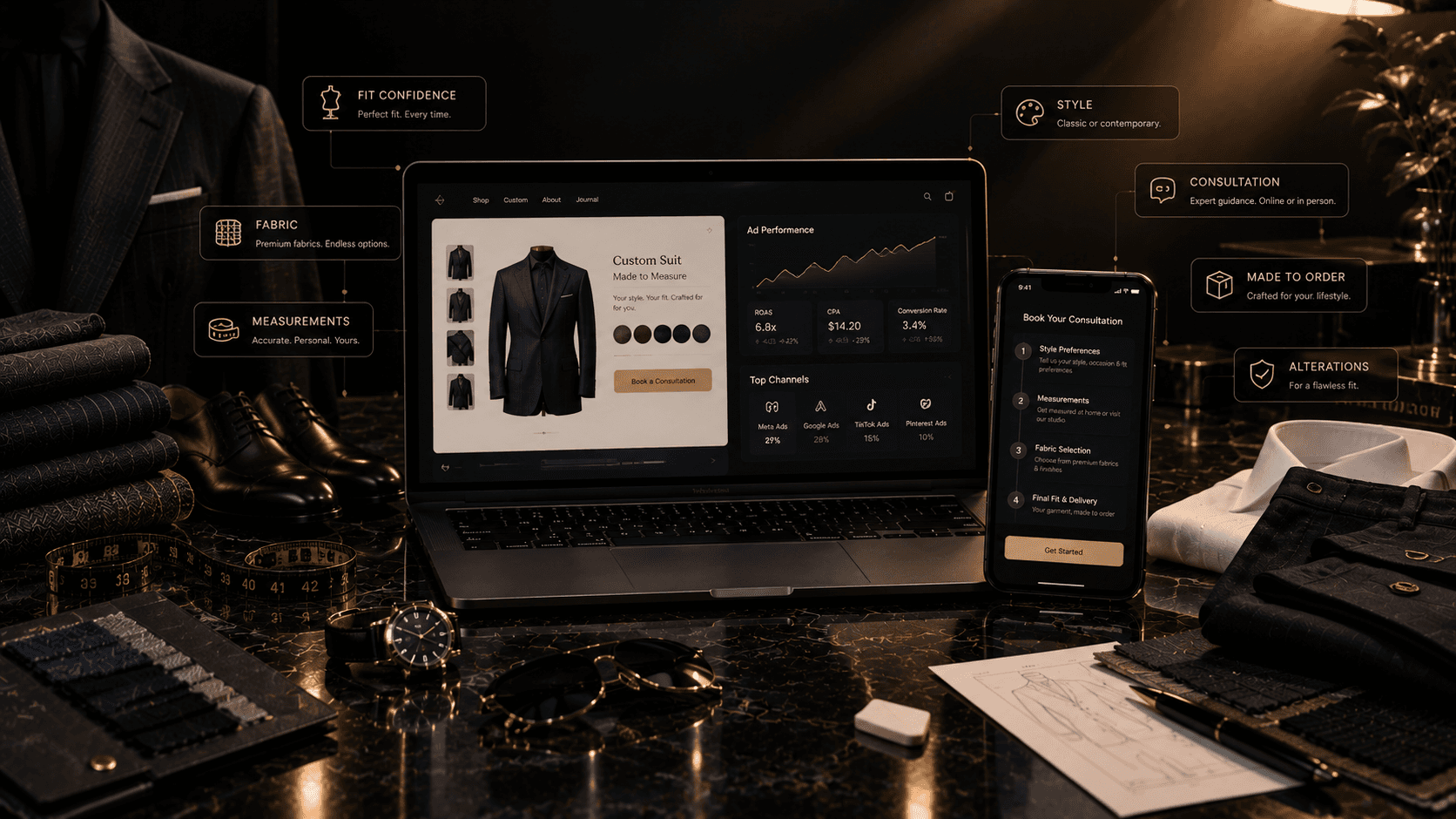
Selling made-to-measure menswear is not the same as selling a standard shirt, blazer, or pair of trousers online.
The customer is not simply choosing a SKU. They are buying fit, craftsmanship, personalization, service, and confidence that the finished product will justify a higher price and a longer wait.
That changes how advertising needs to work.
Effective made to measure menswear marketing has to educate before it sells, reduce uncertainty before asking for commitment, and connect creative, paid media, landing pages, and consultation flows into one customer journey.
For a specialist fashion marketing agency like Veicolo, this category sits at the intersection of fashion storytelling and performance marketing. Veicolo already works across apparel, luxury, menswear, and made-to-order categories, making the same principles behind profitable fashion growth particularly relevant here.
Why Made-to-Measure Menswear Needs a Different Advertising Strategy
Standard fashion ecommerce can often convert through product, price, creative, and convenience.
Made-to-measure has more friction.
A prospective customer may need to understand how measurements work, whether the brand can accommodate their body type, what customization is available, how long production takes, what happens if the fit is wrong, and why the product costs more than ready-to-wear.
That means custom menswear marketing should not jump directly from “see ad” to “buy now.”
In many cases, the funnel needs several trust-building steps between discovery and purchase.
For showroom-based brands, the conversion may be an appointment. For online-first businesses, it may be starting a measurement process, ordering a fitting garment, or completing a configurator.
The ad strategy should reflect the actual buying model.
1. Sell the Outcome, Not Just the Garment
A made-to-measure customer is rarely buying “a navy suit.”
They are buying a navy suit designed around their proportions, preferences, occasion, and style.
Creative should therefore communicate the transformation.
Instead of relying only on polished product photography, show the difference between standard fit and tailored fit. Demonstrate sleeve length, shoulder structure, trouser break, jacket suppression, collar fit, and fabric movement.
The strongest made to order clothing ads make the customization visible.
A close-up of a fabric book, fitting session, hand-finished detail, measurement process, or customer selecting lapels can often communicate more value than another campaign image of a model standing in a studio.
This is where a structured performance creative strategy becomes important. The creative should still feel premium, but every asset should answer a buying question or remove a source of hesitation.
2. Separate Search Intent From Social Discovery
Someone searching “made to measure suit London” has very different intent from someone casually watching a menswear Reel.
Your media strategy should account for that difference.
Google Search should focus heavily on high-intent terms such as “custom wedding suit,” “made to measure business suits,” “bespoke shirts near me,” and specific product-location combinations.
These shoppers already understand the category. Your job is to establish why your service is the right one.
A strong Google Ads strategy for fashion brands can capture those shoppers when they are actively comparing providers.
Meta and TikTok play a different role. They can create demand before the customer has searched.
That is where visual storytelling, transformations, fittings, craftsmanship, styling, testimonials, and founder-led content become more important.
Veicolo's current paid-media model spans Meta, Google, TikTok, Pinterest and other channels rather than treating each channel as an isolated campaign.
3. Build Ads Around the Questions Customers Are Already Asking
One of the easiest ways to improve custom menswear marketing is to turn customer objections into creative concepts.
Think about the questions sales teams hear repeatedly.
“How long does it take?”
“What if my measurements are wrong?”
“Can I choose the lining?”
“Do you do wedding parties?”
“Can you make suits for larger or shorter frames?”
“What happens if it doesn't fit?”
Each question can become an ad.
A 20-second Reel explaining how fittings work may outperform a cinematic brand film because it resolves a real conversion barrier.
The creative can still look premium. It simply needs a job beyond looking good.
4. Use the Tailoring Process as Content
Made-to-order brands have something many ready-to-wear businesses do not: a naturally interesting production process.
Use it.
Show measuring, cutting, fabric selection, pattern adjustments, stitching, pressing, fittings, alterations, finishing, and delivery.
That process helps justify price while reinforcing craftsmanship.
For bespoke clothing ecommerce, this is especially important because customers may never physically enter a showroom.
Your website and advertising have to replace some of the trust normally created by meeting a tailor in person.
Founder videos, tailor-led explanations, workshop footage, and customer fittings make the business feel more tangible.
5. Build Separate Landing Pages for Different Buying Intent
Do not send every ad to the homepage.
Someone searching for a wedding suit should land on a wedding-specific page.
Someone looking for custom business shirts should see a shirt-specific experience.
Someone clicking an ad about remote measurements should land on a page that explains exactly how remote ordering works.
A strong landing page should match the promise made in the ad and continue answering the same intent.
For example, a wedding tailoring page could cover customization, lead times, group fittings, fabric options, consultation booking, customer examples, and FAQs.
This improves relevance and prevents high-intent traffic from having to search through the site for basic information.
6. Make Meta Creative Feel Premium Without Making It Passive
Premium brands sometimes assume performance advertising will cheapen the brand.
It does not have to.
The problem is usually poor creative execution, not performance marketing itself.
A Meta Ads agency for fashion brands can still use direct-response principles while protecting visual identity.
For a made-to-measure label, this may include elegant Reels showing a fitting, carousel ads explaining customization options, testimonial videos, fabric comparisons, and before-and-after fit stories.
The CTA does not always need to be “Buy Now.”
Depending on the funnel, stronger actions may include “Book a Fitting,” “Start Your Design,” “Explore Fabrics,” or “Schedule a Consultation.”
That makes made to order clothing ads more closely aligned with the real customer journey.
7. Retarget With Proof Instead of Repeating the Same Product Ad
A customer who visited once and did not convert probably does not need to see the same hero image another six times.
Retargeting should move the conversation forward.
First show the product.
Then show craftsmanship.
Then show a customer testimonial.
Then answer a fitting objection.
Then show an occasion-specific example.
Then bring the shopper back to a consultation or product page.
This kind of sequencing is particularly valuable when the buying cycle is longer and the price point is higher.
Veicolo's paid-media approach includes full-funnel thinking, dynamic product delivery, creative testing, and retargeting rather than relying on one repeated message.
8. Treat Weddings and Occasions as Their Own Acquisition Funnels
Weddings are not simply another use case for suits.
They are a distinct buying journey.
The groom may be purchasing for himself, coordinating groomsmen, considering multiple fittings, choosing accessories, and working toward a fixed deadline.
Build dedicated wedding campaigns around those needs.
The same principle applies to black tie, business wardrobes, destination weddings, graduation, racing events, and other high-intent occasions.
This gives made to measure menswear marketing more specificity than generic “premium tailoring” messaging.
9. Use Geography Carefully
Physical fitting businesses should structure campaigns around realistic service areas.
A customer may travel further for bespoke tailoring than they would for ordinary clothing, but geography still affects conversion.
Build location-specific search campaigns and landing pages around actual showrooms or service regions.
For digital-first bespoke clothing ecommerce, geography matters differently.
International campaigns should clearly communicate shipping, remote measuring, alteration policies, duties, production times, and whether aftercare is available locally.
The farther the customer is from the brand, the more trust the digital journey needs to create.
10. Measure More Than ROAS
ROAS alone can hide what is actually happening in a made-to-order business.
Track the full commercial funnel.
That means understanding which campaigns generate qualified consultations, how many consultations convert, average order value, customer acquisition cost, contribution margin, repeat-order rate, time to purchase, and revenue by product category.
For showroom brands, “appointment booked” is not enough if those appointments rarely become customers.
For ecommerce brands, a high initial CAC may still work if customers return for shirts, trousers, jackets, or seasonal wardrobe additions.
That is why paid media advertising for made-to-measure should connect media performance with actual business economics rather than optimizing purely for cheap clicks.
Building a Scalable Made-to-Measure Advertising System
The strongest made-to-measure brands do not rely on one beautiful campaign every season.
They build a repeatable system.
High-intent search captures existing demand. Paid social creates new demand. Performance creative explains the value. Landing pages reduce uncertainty. Retargeting builds confidence. Sales and fitting processes complete the conversion.
That is what makes custom menswear marketing different from simply promoting clothes online.
For brands selling customized garments, the objective is not to make tailoring look like ordinary ecommerce.
It is to use performance marketing to communicate exactly why the experience is different.
Final Takeaway
Successful made to measure menswear marketing combines premium storytelling with commercial clarity.
Show the fit. Explain the process. Demonstrate the craftsmanship. Answer objections. Match landing pages to buying intent. Capture high-intent search. Use social creative to create demand. Retarget with proof instead of repetition.
Most importantly, build the advertising around the way customers actually purchase.
For made-to-measure and bespoke clothing ecommerce brands, that often means a longer journey—but it also creates more opportunities to communicate value before asking for the sale.
Veicolo positions its fashion marketing and paid-media services around the same combination of creative testing, platform-native advertising, profitability, and full-funnel growth needed by specialist menswear brands.
FAQs
1. What is made-to-measure menswear marketing?
Made-to-measure menswear marketing focuses on promoting custom-fit clothing through a combination of paid media, performance creative, educational content, landing pages, and retargeting. The goal is to communicate fit, craftsmanship, personalization, and service rather than competing only on price.
2. Which advertising channels work best for made-to-measure menswear brands?
Google Search, Meta, Instagram, TikTok, and retargeting campaigns can all work well. Google captures high-intent searches such as “custom wedding suit” or “made-to-measure suit near me,” while social platforms are better for creating demand through fittings, transformations, craftsmanship, and customer stories.
3. What type of ads perform best for made-to-order clothing brands?
The strongest made-to-order clothing ads usually show the tailoring process, before-and-after fit improvements, fabric selection, customer fittings, testimonials, styling, and specific customization options. Ads that answer real customer questions often perform better than generic product photography alone.
4. Should bespoke menswear brands send paid traffic to the homepage?
Not always. High-intent campaigns usually perform better when traffic lands on a page tailored to the shopper’s intent, such as wedding suits, custom shirts, business tailoring, or consultation booking. Matching the landing page to the ad reduces friction and improves relevance.
5. How can made-to-measure brands reduce customer hesitation online?
Brands can reduce uncertainty by clearly explaining measurements, fit guarantees, alteration policies, production timelines, fabric options, shipping, returns, and the consultation process. Customer testimonials and real fitting content also help build trust.
6. What metrics should custom menswear brands track beyond ROAS?
Brands should also track qualified consultations, consultation-to-sale rate, customer acquisition cost, average order value, contribution margin, repeat purchase rate, time to purchase, and revenue by product category. These metrics give a clearer picture of whether marketing is generating profitable customers.
Featured Case Study


304 %
Scaled Revenue MoM

4x ROAS
consistently over 6 months

125 %
YoY Meta Spend Growth

304 %
Scaled Revenue MoM
OUR APPROACH
Turning Performance Data
Into Profit Clarity
1. Profit-First Measurement
We start where most growth strategies stop: profit. Campaigns, channels, and products are evaluated against margin, contribution, and cash flow—not surface metrics.
2. Marketing Connected to the P&L
Performance data only matters when it maps to financial reality. We align ad spend, customer acquisition, inventory, and lifecycle value into a single decision-making system.
3. Continuous Financial Optimization
Growth isn’t a one-time model. We monitor performance as conditions change—traffic mix, demand, costs—so decisions stay profitable as you scale.




Want to get similar results?
Our Impact,
By The Numbers
RELATED ARTICLES