ARTICLES
Category:
Ads, Creative, Content, and Branding
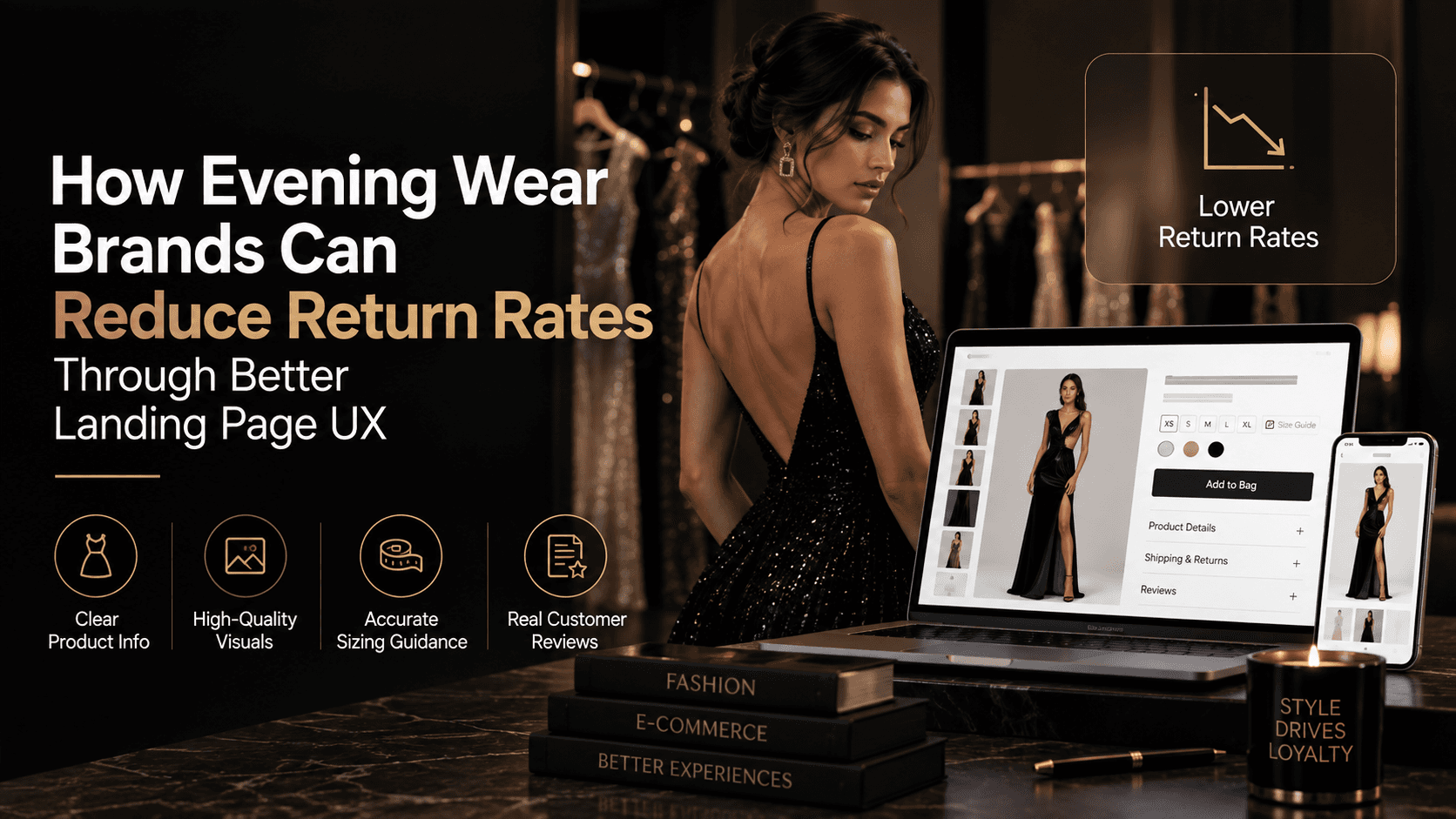
A shopper is getting ready for a wedding reception three weeks out. She finds a gown online, loves the photos, checks the size chart, picks what seems right and orders a second size just in case. The dress arrives. One size gets returned. Sometimes both do, because the fabric felt thinner than expected, or the length hit differently on her frame than it did on the model.
Nothing was defective. Nothing shipped late. And yet this single order just cost the brand two-way shipping, restocking labor, and a customer who now hesitates before her next purchase.
This is the quiet, expensive reality for most occasion and evening wear brands selling online. Return rates in this category run far higher than everyday fashion, and the instinct is usually to fix it downstream better packaging, stricter return windows, tighter courier SLAs. But if you actually want to reduce returns evening wear ecommerce operations struggle with, the real leverage point isn't logistics. It's the landing page the customer saw before they ever clicked Buy.
This piece breaks down why occasion wear returns are so common, exactly where landing pages fail shoppers, and the specific UX fixes that help brands reduce returns evening wear ecommerce businesses can implement without touching their supply chain. If you're trying to reduce returns evening wear ecommerce data keeps flagging it as a problem, the page itself is almost always the first place to look.
Why the Occasion Wear Return Rate Runs So Much Higher Than Everyday Fashion
Before fixing anything, it helps to understand why evening wear behaves so differently from basics. A plain t-shirt is low-risk: if the fit is slightly off, most people keep it anyway. A gown for a cousin's wedding or a cocktail dress for a work event is a single-use, high-stakes purchase. There's no margin for close enough.
That pressure changes shopper behavior in predictable ways:
Buyers over-order deliberately: Ordering two sizes of the same dress with the plan to return one isn't an accident. It's a hedge against a landing page that didn't give them enough confidence to choose correctly the first time.
Festive and wedding-season spikes amplify the problem: In India especially, demand for occasion wear clusters heavily around wedding season and festivals, meaning return volume spikes exactly when operational bandwidth is already stretched thin.
Expectations are emotionally loaded: A shopper isn't just buying fabric, she's buying confidence for a specific moment, which makes any mismatch between expectation and reality feel like a bigger failure than it would for casualwear.
Looking at your occasion wear return rate as a diagnostic tool, rather than just a cost line, changes how you respond to it. A high occasion wear return rate on a specific style is rarely a manufacturing issue. It's usually a sign that the product page set the wrong expectation.
Fit returns (genuinely wrong size) and expectation returns (color, fabric, drape didn't match what was shown) are different problems with different fixes, and most brands don't separate the two when reviewing return data.
If the return isn't about product quality, the next place to look isn't the warehouse. It's the page the customer was standing on when they made the decision. Brands that track their occasion wear return rate style-by-style, rather than as one blended number, usually spot this pattern fast.
The Landing Page UX Gaps That Quietly Drive Up Returns
Most evening wear brands invest heavily in photography and paid traffic, then treat the landing page itself as a formality. That's usually where the leak starts, and it's also where most attempts to reduce returns evening wear ecommerce teams make fall short. They optimize everything except the page the customer actually reads before buying.
A generic S/M/L chart tells a shopper almost nothing useful. It doesn't account for how a fabric stretches, how a hemline falls on different heights, or whether medium in this particular cut runs closer to a size up. A proper evening wear sizing page needs to go further:
Measurements in both inches and centimeters, since Indian shoppers move between both systems depending on habit and region
Notes on fabric stretch and structure, a stiff brocade behaves nothing like a flowy georgette, even at the same size label
A simple visual reference showing how length falls on different heights, not just a single model shot
Without this, shoppers default to guessing and guessing is exactly what drives returns. It's one of the fastest ways to reduce returns that evening wear ecommerce catalogs generate, simply by replacing ambiguity with specifics.
Weak Dress Ecommerce UX in Product Storytelling
Photography built for aesthetics alone often fails at the one job that actually prevents returns: setting accurate expectations. Studio-only shots with perfect lighting can misrepresent color, and static poses tell a shopper nothing about how a dress moves or drapes on a real body. This is one of the most overlooked forms of poor dress ecommerce UX. everything looks beautiful, but nothing feels trustworthy enough to buy with confidence.
Add to this the fact that a large share of ecommerce traffic in India is mobile-first, and any dress ecommerce UX that isn't optimized for fast-loading, easily zoomable mobile imagery is actively working against conversion and return rates at the same time. Fixing this single layer often does more to reduce returns evening wear ecommerce brands see than any change to the return policy itself.
Missing Trust Signals at the Point of Decision
The size selector is the single highest-stakes moment on the page, yet most brands leave it isolated with no supporting context. No verified buyer photos across different body types nearby. No fit-related Q&A. No short video showing how the fabric actually moves when someone walks in it. Shoppers fill that gap with assumptions and assumptions are what get returned.
Common Return Reason | Landing Page UX Fix |
Didn't fit as expected | A detailed evening wear sizing page with fabric stretch notes |
Color looked different online | Multiple lighting angles plus true-to-life video |
Fabric felt cheaper than expected | Fabric composition and drape description near the CTA |
Ordered two sizes to be safe | A fit predictor tool or verified buyer size feedback |
Length wasn't right for my height | A height-based length reference chart |
How to Reduce Returns Evening Wear Ecommerce Brands Can Fix at the Page Level
Once you can see where the page is failing, the fixes are more straightforward than most teams expect and none of them require touching your supply chain.
Rebuild the evening wear sizing page around real bodies, not just numbers:
Add plain-language fit notes per style runs small, true to size, has stretch through the waist instead of relying on measurements alone. Show length comparisons across a few different heights so shoppers can place themselves in the picture, literally. A well-built evening wear sizing page does more work here than any return policy update ever could.
Strengthen the dress ecommerce ux with visual proof, not just prettier photos:
A few seconds of video showing fabric movement does more to prevent a return than another static studio shot. Zoomable, multi-angle images that show texture and embellishment detail help shoppers judge quality honestly before they buy, not after the package arrives.
Guide shoppers before they reach checkout, not after:
A simple not sure which size? prompt, or reviews filtered by height and body type placed right next to the size selector, replaces guesswork with information. Honest copy that flags fit quirks upfront. Rather than glossing over them builds more trust than it costs in conversion.
Brands that make these changes consistently see fewer didn't match expectations returns, because the goal has shifted from selling the dress to correctly setting up the decision. This is the practical core of what it takes to reduce returns evening wear ecommerce teams can actually sustain, season after season, without constantly firefighting reverse logistics.
Turning Landing Page Fixes Into a System, Not a One-Time Project
Fixing a handful of product pages helps immediately, but evening wear brands rarely sell the same collection twice. New fabrics, new silhouettes, and new fit quirks appear every season which means the UX gaps that drove returns last year can quietly resurface in a completely different form this year. A one-time redesign doesn't hold up against that pace of change; what actually works is treating sizing pages, imagery, and trust signals as something to test and refine continuously. That kind of ongoing, structured testing is exactly the territory covered by conversion rate and funnel optimization work.
This is the kind of problem Veicolo, a fashion marketing agency working with apparel and occasion-wear brands, is built to address. Rather than jumping straight into paid traffic, their brand and site audit service is typically the starting point.
Identifying exactly where sizing pages and product UX are quietly working against conversion and return rates before a single additional ad dollar gets spent. It's a useful principle worth repeating: no amount of well-targeted traffic fixes a landing page that's already set the wrong expectations, a point covered in more depth in their Meta Ads scaling playbook for fashion brands. For return issues that trace back to a mismatch between ad creative and what the product page actually delivers, their performance creative strategy work tackles that gap directly.
Conclusion
For any brand still treating this as a courier or policy issue, the fastest way to reduce returns evening wear ecommerce operations face is to start where the customer's decision actually happens. The page, not the parcel. Return rates in evening wear aren't really a shipping problem.
They're a decision-making problem that starts the moment a shopper lands on the page. Vague sizing charts, flat photography, and missing trust signals push customers toward guessing, and guessing is what fills return queues.
Brands serious about working to reduce returns evening wear ecommerce catalogs generate need to treat their sizing pages, imagery, and social proof as core conversion infrastructure not finishing touches added after the product photos are done.
With festive and wedding season demand only intensifying the pressure, auditing these pages now, rather than after the next return spike, is the difference between absorbing losses and actually preventing them.
FAQs
Why do evening wear brands have higher return rates than casualwear brands?
Occasion pieces are single-use, high-stakes purchases where fit and appearance must be right the first time, so shoppers over-order sizes or return items that don't match expectations exactly.
What's the difference between a size chart and a proper sizing page?
A size chart lists numbers; a full sizing page adds fabric stretch behavior, height-based length notes, and fit guidance context that actually helps shoppers choose correctly the first time.
Can better product photography really reduce returns?
Yes. Shoppers who see true color, texture, and movement before buying are less likely to return items over "it looked different online," one of the most common occasion wear complaints.
Should Indian evening wear brands design differently for mobile shoppers?
Absolutely. With mobile-first traffic dominating Indian ecommerce, sizing pages and fit tools must load fast and display clearly on smaller screens, or shoppers abandon or guess sizes.
How often should brands audit their landing pages for return-driving issues?
Ideally each season or collection launch, since new fabrics, silhouettes, and fits introduce fresh UX gaps that weren't present in previous best-performing landing pages.
Is fixing landing page UX cheaper than absorbing return costs?
Generally, yes. UX fixes are a one-time investment, while unresolved return drivers create recurring reverse-logistics costs, lost margin, and damaged customer trust with every reordered item.
Featured Case Study

304 %
Scaled Revenue MoM

4x ROAS
consistently over 6 months

125 %
YoY Meta Spend Growth

304 %
Scaled Revenue MoM
OUR APPROACH
Turning Performance Data
Into Profit Clarity
1. Profit-First Measurement
We start where most growth strategies stop: profit. Campaigns, channels, and products are evaluated against margin, contribution, and cash flow—not surface metrics.
2. Marketing Connected to the P&L
Performance data only matters when it maps to financial reality. We align ad spend, customer acquisition, inventory, and lifecycle value into a single decision-making system.
3. Continuous Financial Optimization
Growth isn’t a one-time model. We monitor performance as conditions change—traffic mix, demand, costs—so decisions stay profitable as you scale.




Want to get similar results?
Our Impact,
By The Numbers
RELATED ARTICLES