ARTICLES
Category:
Ads, Creative, Content, and Branding
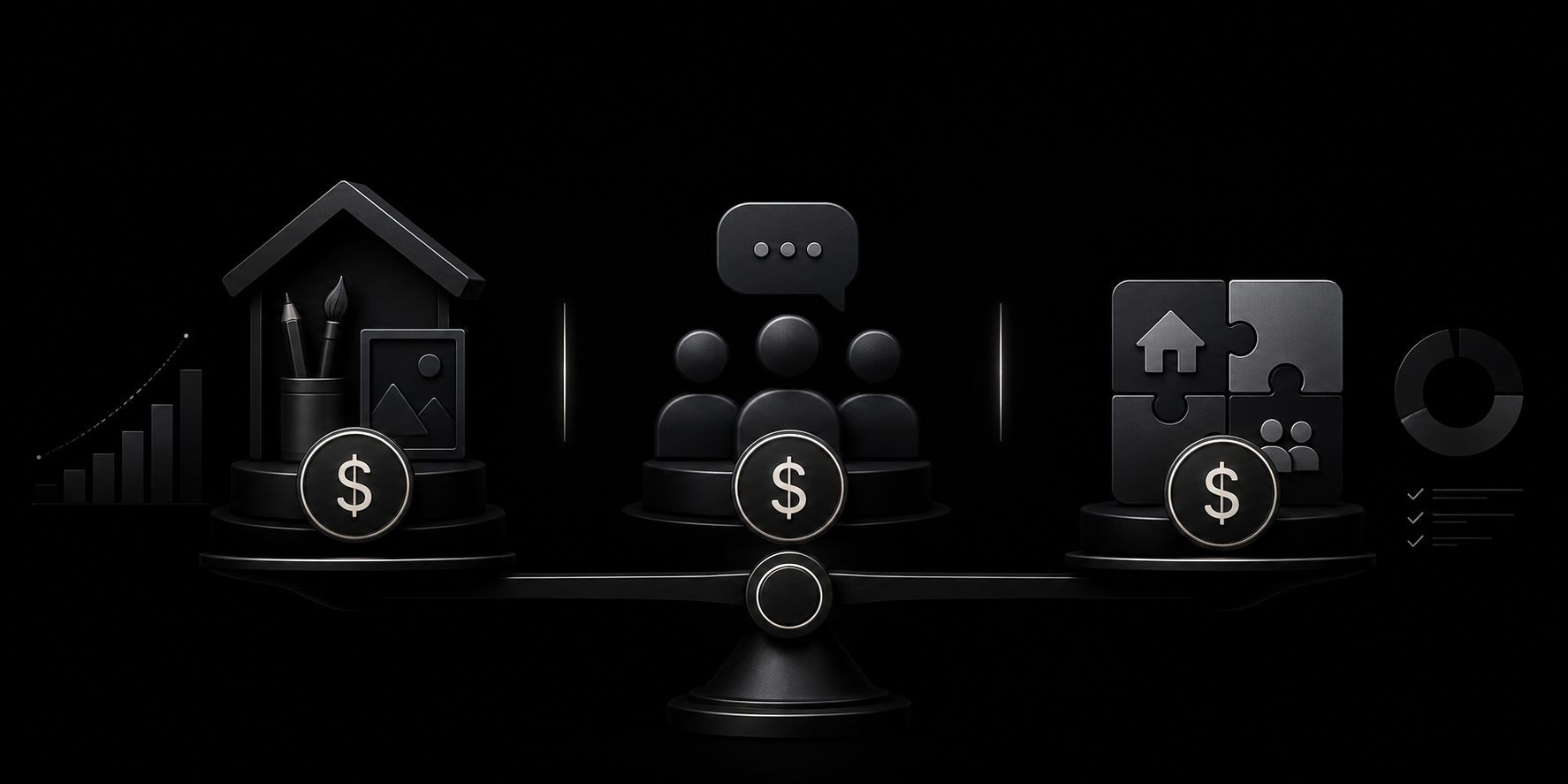
High-growth D2C brands are spending thousands of dollars on paid acquisition every day, but poor or fatigued assets are quietly draining their budgets. If your customer acquisition cost (CAC) is spiking, the ultimate bottleneck usually isn't your ad spend or media buying strategy, it’s your ability to scale high-quality creative output efficiently.
To maintain efficient returns on platforms like Meta, TikTok, and Google, digital-first companies must continuously feed the algorithm with high-converting visual assets.
However, scaling this content pipeline requires a specialized operational structure. Do you build an internal team, outsource completely to an external agency, or blend both into an agile infrastructure?
Demystifying the actual performance creative cost structure across these different operating models is the first step toward scaling sustainably. By understanding how to strategically map out your creative ops budget D2C brands can hit high returns on ad spend (ROAS) without falling into the traps of over-hiring or over-paying. Let’s dive deep into the economics of performance creative pricing to help you choose the best operational model for your growth goals.
What Drives Performance Creative Pricing? The Core Cost Drivers
Before comparing teams and agencies, you must understand exactly what you are paying for. Creative production is no longer just about making beautiful videos; it is a systematic process driven by data analytics and rapid iteration. Three core variables dictate the market rates for performance-driven content.
Volume and Velocity: The Scale of Iteration
Modern ad algorithms thrive on creative diversity. To beat creative fatigue, a brand spending $50,000 a month might need 15 to 20 new creative concepts per month, while an enterprise brand spending $500,000 a month could require hundreds of variations. The sheer velocity of testing hooks, body copy, visual pacing, and calls to action dictates the overall scale of your creative pipeline and directly impacts your baseline overhead.
Talent and Technology Stack Costs
A high-converting ad is rarely the work of a single multi-hyphenate designer. It requires a synchronized team: growth strategists to analyze ad accounts, scriptwriters to write direct-response copy, motion designers, video editors, and project managers to keep timelines on track. Beyond payroll, you also budget for essential software infrastructure including Adobe Creative Cloud, MotionApp for competitive intelligence, and digital asset management tools which quickly adds up to thousands of dollars per year.
Asset Complexity and Production Tiers
Not all assets are priced equally. A simple static graphic or a low-fidelity user-generated content (UGC) smartphone video edited with native text overlays requires minimal studio setup. On the other end of the spectrum, high-fidelity studio shoots involving professional lighting, camera crews, lifestyle models, and custom set designs require significant upfront capital, introducing entirely different operational pricing tiers.
Model 1: The In-House Team - True Performance Creative Cost Breakdown
Building an internal creative studio gives a brand absolute control over its visual identity and daily output. When your creative assets are produced by full-time employees who eat, sleep, and breathe your brand guidelines, the consistency of your messaging is unmatched. However, building an internal studio comes with distinct financial realities.
The Hidden Costs of an Internal Creative Studio
Many growth marketers make the mistake of calculating in-house costs solely based on base salaries. In reality, the true performance creative cost of an internal team includes payroll taxes, healthcare benefits, recruitment fees, onboarding time, and performance bonuses. To build a minimum viable in-house performance unit, you need at least one growth creative strategist, a dedicated video editor, and a graphic designer. This skeletal team easily carries a fixed overhead of $250,000 to $350,000 annually before factoring in any production equipment or software tools.
Efficiency vs Fixed Overhead Risks
The primary risk of a fully in-house model is its lack of financial flexibility. If your performance dips due to shifting market dynamics or iOS updates, your internal payroll remains completely fixed. Furthermore, internal teams can easily become an echo chamber, losing sight of broader industry trends, platform algorithm changes, and creative tactics working outside your specific niche.
Budgeting for the In-House Infrastructure
To structure an internal creative ops budget D2C brands must treat creative production as a profit-and-loss center. If your internal team cannot produce a steady volume of winning ads to justify their fixed monthly overhead, your cost-per-winning-asset rises dramatically. For brands prioritizing extreme control over rapid experimentation, this investment is a strategic choice, but it requires highly consistent monthly spend to remain economically viable.
Model 2: The Agency Approach - Evaluating Ad Creative Agency Pricing
Outsourcing production to a dedicated agency allows D2C brands to instantly skip the recruitment phase and gain immediate access to a team of battle-tested direct-response experts.
Standard Agency Fee Structures Demystified
When analyzing ad creative agency pricing, you will typically encounter three distinct structures:
Monthly Retainers: A fixed fee (typically ranging from $4,000 to $12,000/month) for a guaranteed volume of deliverables (e.g., 20 videos and 15 statics per month).
Per-Asset Pricing: A project-based model where you pay a flat rate per deliverable (e.g., $300 per static ad or $600 per primary UGC video concept).
Performance Incentives: A hybrid structure featuring a lower baseline retainer combined with a percentage of ad spend or a percentage of net revenue generated by the winning creatives they produce.
The Core Benefits: Immediate Scale and Diverse Expertise
The distinct advantage of an agency is cross-account visibility. Because agencies manage multiple accounts across diverse D2C verticals, they recognize emerging visual trends, algorithm updates, and successful hook formats weeks before an isolated in-house team does. They also absorb the overhead of software licenses, asset management, and editor churn, giving you a scalable plug-and-play solution.
Spotting Red Flags in Creative Retainers
Not all agencies are built for direct-response marketing. When evaluating ad creative agency pricing, beware of traditional branding agencies that emphasize aesthetic vanity metrics over concrete data points like
Hook Rate
Hold Rate
Outbound click-through rates (CTR)
A beautiful ad that fails to convert traffic is a net loss for a scaling D2C brand.
Model 3: The Hybrid Matrix - Maximizing Your Creative Ops Budget D2C
For high-growth brands seeking the optimal balance between cost efficiency and creative control, the hybrid model has emerged as the modern gold standard. This approach combines internal strategic oversight with external production speed.
What is the Hybrid Performance Creative Model?
In a hybrid model, a D2C brand retains a core internal team usually a Growth Marketing Director. Who deeply understand the brand’s positioning, margins, and customer psychology. This lean internal team handles high-level strategy, data analysis, and brand compliance, while outsourcing heavy execution tasks like video editing, volume iteration, and asset variations to an agile external partner.
Why Hybrid Optimizes Performance Creative Cost
The hybrid matrix prevents you from over-hiring during peak seasons (like Q4) only to be weighed down by idle overhead during slower months (like January). By utilizing a specialized partner to scale variations of your top-performing hooks and concepts, you lower your average performance creative cost per asset. You only pay for execution capacity when your ad account actively demands it.
Structuring Workflows for Flawless Collaboration
To maximize your hybrid creative ops budget D2C systems must be built on seamless data transparency. Your internal growth team should share real-time platform metrics (such as 3-second video view rates and ROAS) directly with your external production partner. This rapid feedback loop allows the external team to instantly generate variations of winning concepts, doubling down on what works within 48 hours.
Comparative Matrix: Performance Creative Pricing Across All Models
Choosing the right operational framework requires comparing how each model handles production velocity, costs, and scalability. Below is an overview of how the three creative ops models stack up side by side.
Operational Metric | In-House Studio Model | Fully Outsourced Agency | Hybrid Creative Matrix |
Speed to Market | Fast, but restricted by bandwidth | Dependent on agency workflows | Extremely fast for iterations |
Scalability of Volume | Rigid; requires more hiring | Scalable based on retainer tiers | Hyper-scalable on-demand |
Platform Expertise | Insular to your brand | Broad; cross-industry data | Deeply tailored + market-aware |
Control Over Brand | Maximum | Moderate to High | High Strategic Control |
The Direct ROI of Strategic Content Allocation
When evaluating your baseline performance creative pricing model, consider your quarterly marketing calendar. A rigid in-house model makes scaling down during lower-spend periods nearly impossible. A flexible structure, however, allows you to dynamically shift your budget from asset creation directly into paid distribution channels during hyper-competitive periods, maximizing your overall bottom-line efficiency.
How to Choose Your Model Based on Your Monthly Ad Spend
Your optimal organizational structure is heavily dependent on your monthly paid acquisition volume. As your media spend increases, your creative infrastructure must evolve alongside it.
Tier 1: Spending Under $30k/Month - Lean & Agile
At this foundational stage, your primary goal is finding initial product-market fit and testing core marketing angles. You do not need a massive agency retainer or full-time editors. Minimize your performance creative cost by leveraging freelance networks, founder-led content creation, and basic automated editing software to maintain a lean, agile testing framework.
Tier 2: Spending $30k - $100k/Month - The Growth Squeeze
This is the phase where creative fatigue becomes a major challenge. Your customer acquisition costs begin to climb because your audience sees the same ads repeatedly. This is where standard ad creative agency pricing begins to make clear financial sense. Partnering with an external team gives you the infrastructure needed to produce dozens of monthly asset variations to stabilize your ad account.
Tier 3: Spending $100k+/Month - Enterprise Hybrid Setup
At this level, you are spending millions of dollars annually on paid media. Relying solely on an external agency can lead to communication gaps, while relying entirely on an in-house team introduces severe bottlenecks. The solution is an enterprise hybrid setup. By leveraging an optimized hybrid model, you maintain a highly agile creative engine capable of feeding the ad algorithms with a continuous supply of high-converting winners.
Why Partnering with Veicolo Optimizes Your Performance Creative Pricing
Finding a reliable creative production partner who respects your margins and speaks direct-response data can be a challenge. That is exactly why we built our service model from the ground up.
Veicolo acts as the plug-and-play production engine for your existing marketing setup. Whether you need to augment a lean internal team or replace an underperforming agency, we integrate directly into your communication channels and data dashboards. We supercharge your creative ops budget D2C framework by delivering high-velocity, high-quality assets tailored entirely to your brand’s specific growth goals.
Contact us today to schedule a custom creative strategy audit for your brand.
Conclusion
Selecting the right operational model is an ongoing balancing act between brand control, output volume, and direct cost-per-asset metrics. There is no one-size-fits-all solution, but understanding your cost drivers ensures you won't overpay for your assets. Don't let rigid corporate overhead or unoptimized creative retainers eat away at your paid acquisition margins.
Frequently Asked Questions
Q1: What is the average performance creative cost for a growing D2C brand?
A: On average, brands spend between $3,000 and $10,000 monthly. This varies heavily based on asset volume, testing velocity, and whether production is handled in-house or outsourced.
Q2: How does standard ad creative agency pricing typically work?
A: Agencies usually charge a flat monthly retainer for a set volume of deliverables, a per-asset fee, or a performance incentive mapped directly to your monthly ad spend.
Q3: How should a CMO balance their creative ops budget for D2C during peak seasons?
A: Maintain a lean internal team for brand strategy and partner with a flexible agency to scale asset production volume seamlessly during high-velocity periods like Q4.
Featured Case Study


304 %
Scaled Revenue MoM


4x ROAS
consistently over 6 months


125 %
YoY Meta Spend Growth

304 %
Scaled Revenue MoM
OUR APPROACH
Turning Performance Data
Into Profit Clarity
1. Profit-First Measurement
We start where most growth strategies stop: profit. Campaigns, channels, and products are evaluated against margin, contribution, and cash flow—not surface metrics.
2. Marketing Connected to the P&L
Performance data only matters when it maps to financial reality. We align ad spend, customer acquisition, inventory, and lifecycle value into a single decision-making system.
3. Continuous Financial Optimization
Growth isn’t a one-time model. We monitor performance as conditions change—traffic mix, demand, costs—so decisions stay profitable as you scale.



Want to get similar results?
Our Impact,
By The Numbers
RELATED ARTICLES