ARTICLES
Category:
Ads, Creative, Content, and Branding
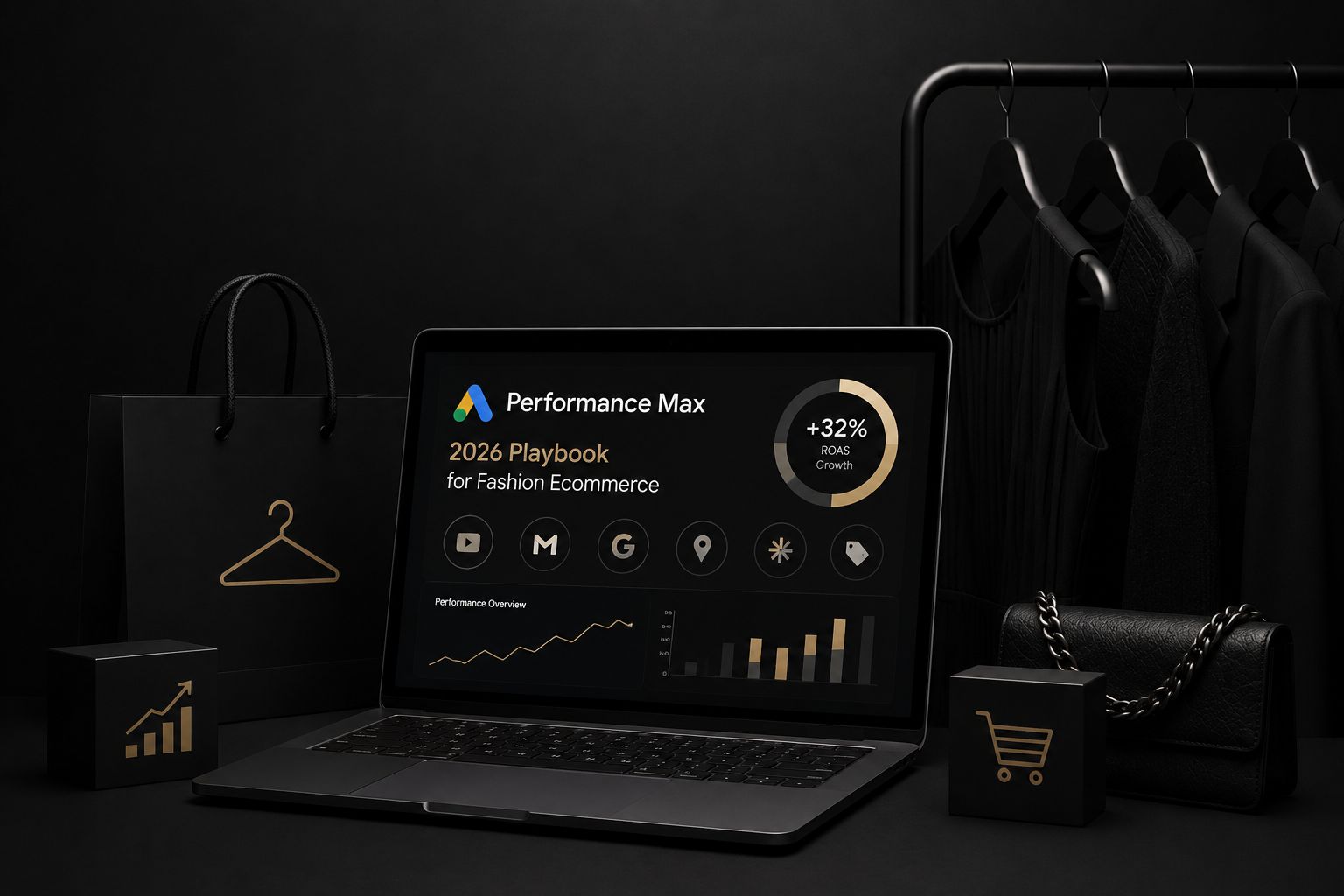
Google Performance Max for Fashion Ecommerce: A 2026 Playbook
A contemporary womenswear brand flips on Performance Max, spends $40,000 in a month, and watches the dashboard report a 6x ROAS. Champagne, right? Then the analyst pulls the search-terms data and finds 80% of that "return" came from people typing the brand name — traffic the brand would have won for free. Net-new customer acquisition was a fraction of the headline. This is the Google Performance Max trap, and fashion brands fall into it constantly.
Performance Max can be one of the most profitable channels in fashion ecommerce — or a budget furnace that dresses up branded search as incremental growth. The difference is entirely in how you structure it. Here's the 2026 playbook.
What Google Performance Max is — and why fashion brands struggle with it
One campaign serves ads across Search, Shopping, YouTube, Display, Gmail, Discover, and Maps. That's Performance Max: Google's fully automated campaign type. You feed it a product catalog, creative assets, audience signals, and a goal; the machine decides placement, bid, and targeting. For a busy fashion brand, that automation is the appeal — and the problem.
It's a black box
A standard Shopping campaign shows you which products, search terms, and placements drive sales. Google Performance Max hides most of it by default. You get campaign-level numbers and a fraction of the detail. When a $340 dress starts eating budget with no returns, you can't always see it without extra work.
Brand-search cannibalization
Left unchecked, PMax gobbles your branded queries because they convert best — then claims credit for demand you already owned. That inflates reported ROAS and hides weak prospecting. For fashion brands with real name recognition, this is the number-one cause of "great dashboard, flat growth."
Asset quality and brand safety
PMax will auto-generate combinations and place your $600 handbag next to junk Display inventory if you let it. For luxury and premium fashion, that's a brand-safety issue, not just a performance one. Weak assets in, weak and off-brand placements out.
How to structure Google Performance Max for fashion ecommerce
A brand restructures a messy setup and the same budget starts producing new customers instead of rebranded search. Six moves do the heavy lifting.
Start with the product feed
Your feed is 70% of PMax performance in ecommerce. Titles, images, product types, GTINs, custom labels. A dress titled "Wrap Dress" loses to one titled "Silk Wrap Midi Dress — Emerald — Wedding Guest." Custom labels let you tag by margin, season, bestseller, and full-price vs markdown, so you can steer spend toward the products that actually make money. Fix the feed before you touch anything else.
Two feed moves pay off fast in apparel. Front-load the searchable attributes — fabric, color, occasion, silhouette — into the first 60 characters of the title, where Google weights them most. And use a supplemental feed to suppress the SKUs that quietly drain budget: out-of-stock sizes, deep-markdown items with no margin left, and low-converting colorways. A tighter feed of products that can actually sell beats a bloated one every time.
Build asset groups by collection
One giant asset group is lazy and untrackable. Structure asset groups to mirror how you merchandise: by collection or category — dresses, knitwear, outerwear, new arrivals. Each gets its own images, headlines, video, and audience signal. Now performance maps to a real merchandising unit you can read and act on.
Feed strong audience signals
Audience signals don't target; they teach. Give PMax your best data: past purchasers, high-LTV cohorts, cart abandoners, and detailed custom-intent segments built from competitor and category searches. Better signals mean a faster, smarter ramp out of the learning phase.
Set brand exclusions
This is the one most brands miss. Add brand exclusions (or use the brand-list feature) so PMax stops claiming branded search, and run a separate, cheap branded Search campaign to defend the term. Now your PMax ROAS reflects real prospecting, not recycled demand.
Use new-customer acquisition value rules
Turn on new-customer acquisition and assign a higher value to first-time buyers. This tells Google to optimize for net-new customers, not just the easiest repeat conversion. In a repeat-purchase category like fashion, acquiring the customer is the point — LTV pays you back later.
Meet the creative requirements
PMax is hungry for assets: multiple image ratios, several headlines and descriptions, and — critically — video. If you don't supply video, Google auto-generates ugly ones from your images. Fashion is a visual sell; feed it product-in-motion, styling, and UGC. This is where performance creative and Google structure meet.
Performance Max vs standard Shopping and Search
A team argues for weeks about PMax vs Shopping. Wrong framing. They're not either/or.
Standard Shopping and Search give you control and transparency: exact search terms, product-level bids, negative keywords. Performance Max gives you reach and automation across every Google surface. The strongest fashion accounts run them together — PMax for scaled prospecting across the catalog, standard Search to defend brand and own high-intent non-brand terms, and sometimes standard Shopping for tight control on hero products. The full breakdown lives in our guide to Google Ads best practices for fashion ecommerce.
Reporting and transparency workarounds
You can't optimize what you can't see, and PMax hides plenty. Three workarounds crack it open. Run PMax scripts (free, community-built) to surface search terms, placements, and asset-group breakdowns. Pull channel and placement insight through the reporting scripts and API where the interface won't show it. And watch the search-terms and "insights" tabs weekly to catch branded creep and junk placements early. This is standard operating procedure in professional Google Ads management, not a nice-to-have.
Measuring incrementality
Reported ROAS says 6x. The real question: how many of those sales would have happened anyway? Two ways to know. Run a geo lift test — hold PMax in a set of matched regions, run it in others, compare the difference. Or use Google's experiment tools to measure incremental conversions against a holdout. Pair that with your blended numbers: total new customers and blended CAC across the whole account. If PMax scales while blended CAC stays flat and new-customer count climbs, it's incremental. If ROAS looks great but blended CAC creeps up, you're paying for branded search.
Set a cadence, too. Read PMax weekly for branded creep and junk placements, but judge incrementality on a 30-to-90-day window — the ramp and seasonality in fashion make shorter reads noisy. One clean holdout test a quarter tells you more than staring at the dashboard every morning.
When Performance Max is right — and when it's wrong
PMax is right when you have a healthy product feed, real catalog depth, decent conversion data flowing to Google, and the discipline to exclude brand and measure incrementality. For an established fashion brand with 200+ SKUs and clean tracking, it's often the most scalable channel you've got.
PMax is wrong when you're pre-product-market-fit, have a thin catalog, weak or broken conversion tracking, or no video assets — and no plan to exclude brand. In that case you'll spend into a black box and call recycled demand "growth." Fix the fundamentals first.
How Veicolo runs Performance Max for fashion brands
A brand hands over a PMax account reporting 5x and hiding the fact that new-customer CAC is underwater. The rebuild starts with the feed, brand exclusions, and new-customer value rules — then creative.
Veicolo is a Los Angeles performance agency for fashion, luxury, and DTC, and Google Performance Max is treated as one piece of a profit-first Google strategy, not a set-and-forget button. The team ties every campaign to blended CAC and contribution margin, feeds PMax the volume of performance creative it needs to work — part of the 120K+ creatives launched across the portfolio — and structures accounts so brands see real incremental growth. The result, typically inside three months, is around 40% better ROAS and roughly 27% lower CAC — because the account is built to acquire new customers, not to relabel demand you already had.
PMax also rarely stands alone; it's one lane in a full-funnel plan alongside Meta, retention, and channels like TikTok Shop for fashion brands. If you'd rather hand the whole engine to specialists, that's the case for a fashion ecommerce marketing agency for fashion brands that runs media, creative, and measurement as one system.
FAQ
Does Performance Max cannibalize branded search?
Yes, unless you stop it. By default PMax serves on branded queries and claims that easy-to-win demand, inflating ROAS. Use brand exclusions and run a separate branded Search campaign so your PMax numbers reflect real prospecting.
How many asset groups should a fashion brand run in Performance Max?
Mirror your merchandising — one asset group per collection or category (dresses, knitwear, outerwear, new arrivals), each with its own creative and audience signal. That structure keeps performance readable and steerable.
Is Performance Max better than standard Shopping for ecommerce?
Neither is "better." PMax scales prospecting across every Google surface; standard Shopping and Search give control and transparency. Strong fashion accounts run them together and defend brand terms separately.
How do I see the hidden data in Performance Max?
Use community PMax scripts and the Google Ads API to surface search terms, placements, and asset-group performance the standard interface hides — then review weekly to catch branded creep and low-quality placements.
Key takeaways
Google Performance Max can drive scaled, profitable growth for fashion ecommerce — or disguise branded search as new customers. Structure decides which.
The feed is 70% of the game: optimize titles, images, and custom labels before anything else.
Set brand exclusions and turn on new-customer acquisition value rules so you pay for net-new customers, not recycled demand.
Break the black box with PMax scripts and measure real incrementality with geo or holdout tests, judged on blended CAC.
Run PMax alongside standard Search and Shopping, not instead of them.
Want Performance Max structured to acquire customers instead of relabeling demand? Book a call with Veicolo for a Google strategy built around profit.
Featured Case Study


304 %
Scaled Revenue MoM


4x ROAS
consistently over 6 months


125 %
YoY Meta Spend Growth


304 %
Scaled Revenue MoM
OUR APPROACH
Turning Performance Data
Into Profit Clarity
1. Profit-First Measurement
We start where most growth strategies stop: profit. Campaigns, channels, and products are evaluated against margin, contribution, and cash flow—not surface metrics.
2. Marketing Connected to the P&L
Performance data only matters when it maps to financial reality. We align ad spend, customer acquisition, inventory, and lifecycle value into a single decision-making system.
3. Continuous Financial Optimization
Growth isn’t a one-time model. We monitor performance as conditions change—traffic mix, demand, costs—so decisions stay profitable as you scale.




Want to get similar results?
Our Impact,
By The Numbers
RELATED ARTICLES