ARTICLES
Category:
Ads, Creative, Content, and Branding
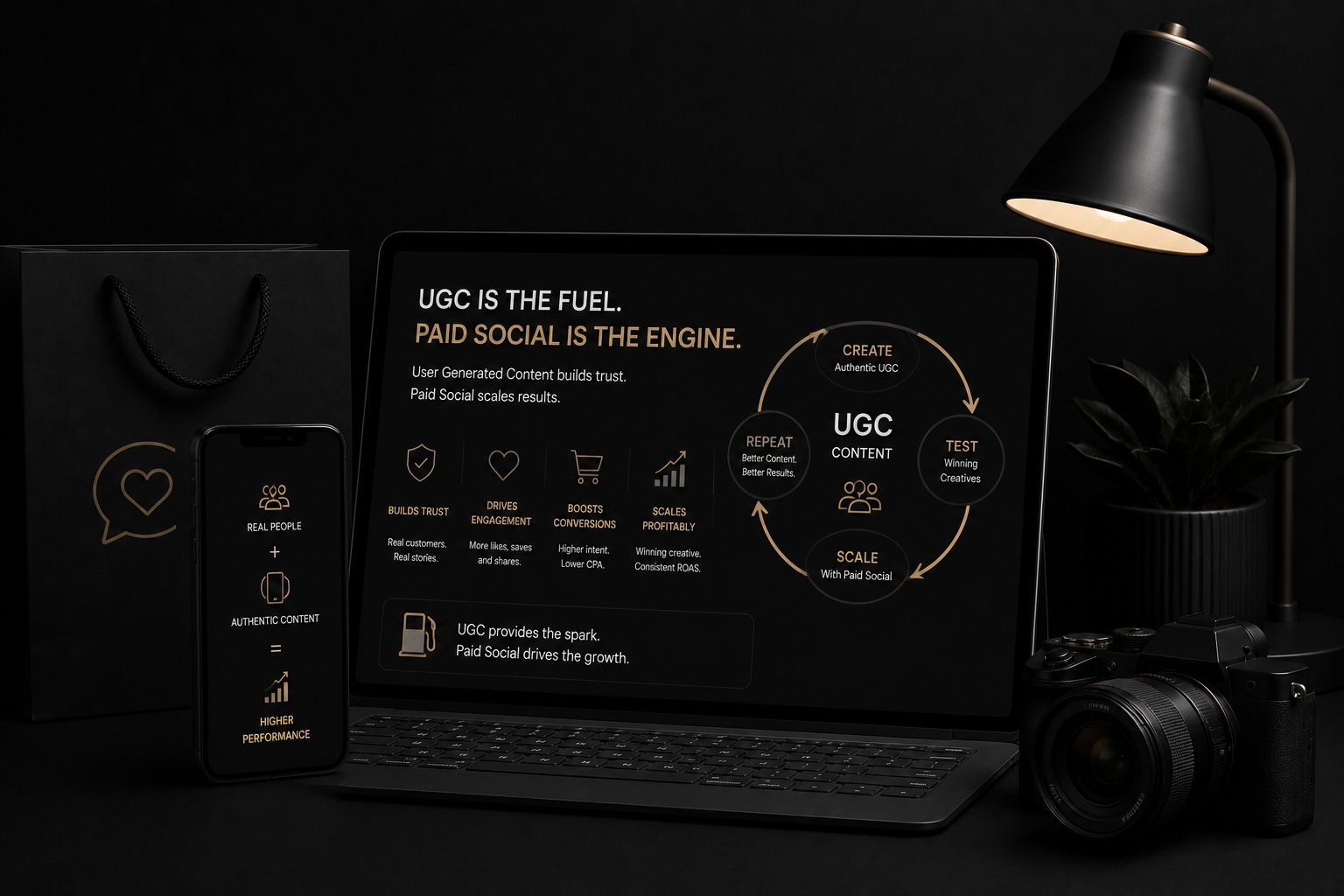
A fashion brand scales to $200K a month on Meta with four winning video ads. Then fatigue hits. CTR drops, CPMs climb, and the account that printed money for a quarter starts bleeding. The brand has no pipeline of fresh content, so it can't test its way out. This is the most common death spiral in paid social, and it has one root cause: no content engine. User generated content marketing isn't a nice-to-have for fashion brands — it's the fuel your paid media burns, and if you run out, you stall.
Here's how to build a repeatable UGC and creator engine: sourcing, briefs that produce winning ads, usage rights, whitelisting, and the testing discipline that ties it all to profit.
Why user generated content marketing is the fuel for paid social
Paid social is a creative game now. Targeting is largely automated, so the ad itself is the variable you control — and the account with more fresh, testable creative wins. That's the whole reason volume matters.
Think about the math. If one in five concepts becomes a winner, you need to produce five to find one, and twenty-five to find five. A brand shipping two ads a month tests its way to a winner slowly and dies during every fatigue cycle. A brand shipping twenty tests its way to several and always has the next winner ready.
User generated content marketing is how you hit that volume affordably. Creator content is native, fast to produce, and cheap relative to full studio shoots — and it converts because it looks like the platform, not like an ad. For fashion specifically, UGC shows the product in motion, on real bodies, in real light. That's what a considered buyer needs to see. Strong ugc for fashion brands is the difference between a creative library that lasts a quarter and one that lasts a week.
Building the engine: a repeatable system, not one-off gifting
Most brands treat creators as a series of one-off transactions. Send free product, hope for a post, repeat. That's not an engine — it's a lottery. A real system runs on four repeatable stages: sourcing, briefing, rights, and distribution.
Sourcing creators
Start with fit, not follower count. For performance content, a creator's audience size barely matters — you're using their content in ads, not their reach. What matters is whether they look like your customer, shoot clean footage, and can deliver on a brief.
Build a sourcing pipeline from three places:
Your own customers. The best UGC often comes from people who already love the brand. Mine reviews, tags, and DMs.
Creator platforms and marketplaces. Faster to scale, with vetted creators and clearer rights.
Organic outreach. Micro-creators who already post in your aesthetic are usually eager and affordable.
Keep a running roster. The goal is a bench you can activate on demand, not a scramble every launch.
Writing briefs that produce winning ads
A vague brief gets you a pretty video that doesn't sell. A sharp brief gets you an ad. The difference is direction. Great briefs specify the hook (the first three seconds), the problem or desire, the proof, and the call to action — while leaving the creator room to sound like themselves.
Brief for the funnel stage:
Top of funnel: hook-led content. Pattern interrupts, bold claims, trend-native openers. The job is to stop the scroll.
Mid funnel: proof-led content. Try-ons, styling, before-and-afters, honest reviews, "why I keep reaching for this." The job is to convince.
Give creators reference ads, a clear do/don't list, and the specific hooks you want tested. One shoot should produce multiple hook variations so you can test openers against the same body. That's how you turn one creator session into ten testable ads.
Negotiating usage rights
This is where brands get burned. A creator posting on their own page is not the same as you running their content as a paid ad. You need explicit paid usage rights — ideally including whitelisting — written into the agreement, with a defined term and scope. Sort this up front. Discovering you don't have rights to your best-performing ad is an expensive lesson.
Whitelisting, Spark Ads, and Partnership Ads
The highest-performing format in fashion social is often the creator's content running from the creator's own handle, as a paid ad. On Meta this is Partnership Ads (formerly branded content / whitelisting); on TikTok it's Spark Ads. The ad carries the creator's name and social proof — likes, comments, credibility — which lifts trust and performance versus the same video from your brand handle. Build usage rights and handle access into your creator deals so you can run these from day one.
Matching content to the funnel
A single creative can't do every job. The engine should produce a spread mapped to where the customer is.
Hooks for the top. High-volume, disposable, testable openers designed to win attention. Expect most to lose — that's the point. You're mining for the few that pop.
Proof for the middle. Reviews, demonstrations, and styling that convert interest into intent. These have longer shelf lives and reward higher production care.
Retargeting closers. Testimonials, UGC objection-handlers, and offer-led content for warm audiences.
Fashion sub-categories need different proof. A jewelry brand leans on macro detail and on-body scale; anyone building a jewelry marketing strategy knows trust and visual detail carry the sale, so proof-led UGC does heavy lifting there. Apparel leans on fit and movement. Match the content type to what the buyer needs to see before spending.
Testing at scale — the real discipline
Volume without discipline is just expensive noise. The engine only pays off if you test systematically and read results at the creative level.
Run a structured cadence: ship a batch of concepts, give each enough budget and time to exit learning, then judge on creative-level ROAS and cost per acquisition — not campaign-level averages. Campaign ROAS hides which specific ad is carrying the account. Creative-level data tells you exactly which hook, creator, and format to scale and which to cut.
This is where scale compounds. Veicolo has launched 120K+ performance creatives, and the reason is simple: you can't predict winners, so you build a system that produces and tests enough to find them reliably. That discipline is what drives roughly 40% ROAS improvement within three months and about 27% lower CAC — not one lucky viral video, but a repeatable creative testing machine. Winning fashion brands treat creative testing as an operating rhythm, not a project.
Keeping premium fashion brand-safe
There's a real tension for luxury fashion brands: UGC that converts can read as "cheap," and cheap kills a premium brand. The fix isn't avoiding UGC — it's directing it. Cast creators who match your brand's aesthetic and world. Set clear guardrails on wardrobe, setting, tone, and language. Blend raw creator authenticity with brand-level art direction so the content feels native without feeling off-brand or "cringe."
Premium and performance aren't opposites. The best fashion UGC looks effortless and native while still respecting the brand's codes. That balance is a craft, and it's exactly what strong ugc ads for fashion get right — authentic enough to convert, controlled enough to protect equity.
How a performance agency runs the engine
Building this in-house is possible, but most fashion teams lack the throughput. A performance partner runs it as a machine: a sourcing pipeline, briefs engineered for winners, airtight rights and whitelisting, and creative-level testing wired to profit. That's the backbone of Veicolo's UGC ads services — a system that keeps a fresh, testable content library flowing so paid social never stalls on creative fatigue. Run at scale, user generated content marketing stops being a content headache and becomes a growth system.
If you're starting from scratch, the first step is process, not volume. Here's a practical guide to how to enable UGC marketing for your fashion brand — the sourcing, rights, and workflow that make the engine repeatable. And because the engine feeds every channel, brands should pair it with TikTok Shop, where native creator content and shoppable video convert in the same feed they're discovered in.
The brands that win paid social aren't the ones with the single best ad. They're the ones that never run out of the next one.
FAQ
What's the difference between UGC and influencer marketing? Influencer marketing buys a creator's reach to post to their audience. UGC buys the content itself to run as your ads. For performance, follower count barely matters — the content and usage rights do.
How much UGC does a fashion brand need? Enough to test continuously and beat creative fatigue — think a steady batch of fresh concepts every week, not a handful per quarter. Volume is what lets you find and scale winners.
Do I need paid usage rights for creator content? Yes. A creator posting on their page is not the same as running their video as a paid ad. Secure explicit paid usage rights and, ideally, whitelisting (Partnership Ads / Spark Ads) in writing, with a defined term.
How do I measure UGC ad performance? At the creative level — cost per acquisition and ROAS per ad — not campaign averages. That tells you which specific hook, creator, and format to scale.
Key takeaways
UGC is the fuel for paid social; you need volume to test your way to winners and beat fatigue.
Build a repeatable engine: sourcing, sharp briefs, airtight usage rights, and whitelisting.
Match content to the funnel — hook-led at the top, proof-led in the middle.
Test at scale and judge creative-level ROAS, not campaign averages.
Keep premium brands safe by directing UGC with clear guardrails, not avoiding it.
Running low on fresh creative? Talk to Veicolo and we'll build the UGC and creator engine that keeps your fashion brand's paid social scaling.
Featured Case Study


304 %
Scaled Revenue MoM


4x ROAS
consistently over 6 months


125 %
YoY Meta Spend Growth


304 %
Scaled Revenue MoM
OUR APPROACH
Turning Performance Data
Into Profit Clarity
1. Profit-First Measurement
We start where most growth strategies stop: profit. Campaigns, channels, and products are evaluated against margin, contribution, and cash flow—not surface metrics.
2. Marketing Connected to the P&L
Performance data only matters when it maps to financial reality. We align ad spend, customer acquisition, inventory, and lifecycle value into a single decision-making system.
3. Continuous Financial Optimization
Growth isn’t a one-time model. We monitor performance as conditions change—traffic mix, demand, costs—so decisions stay profitable as you scale.




Want to get similar results?
Our Impact,
By The Numbers
RELATED ARTICLES