ARTICLES
Category:
Paid Ads Strategy
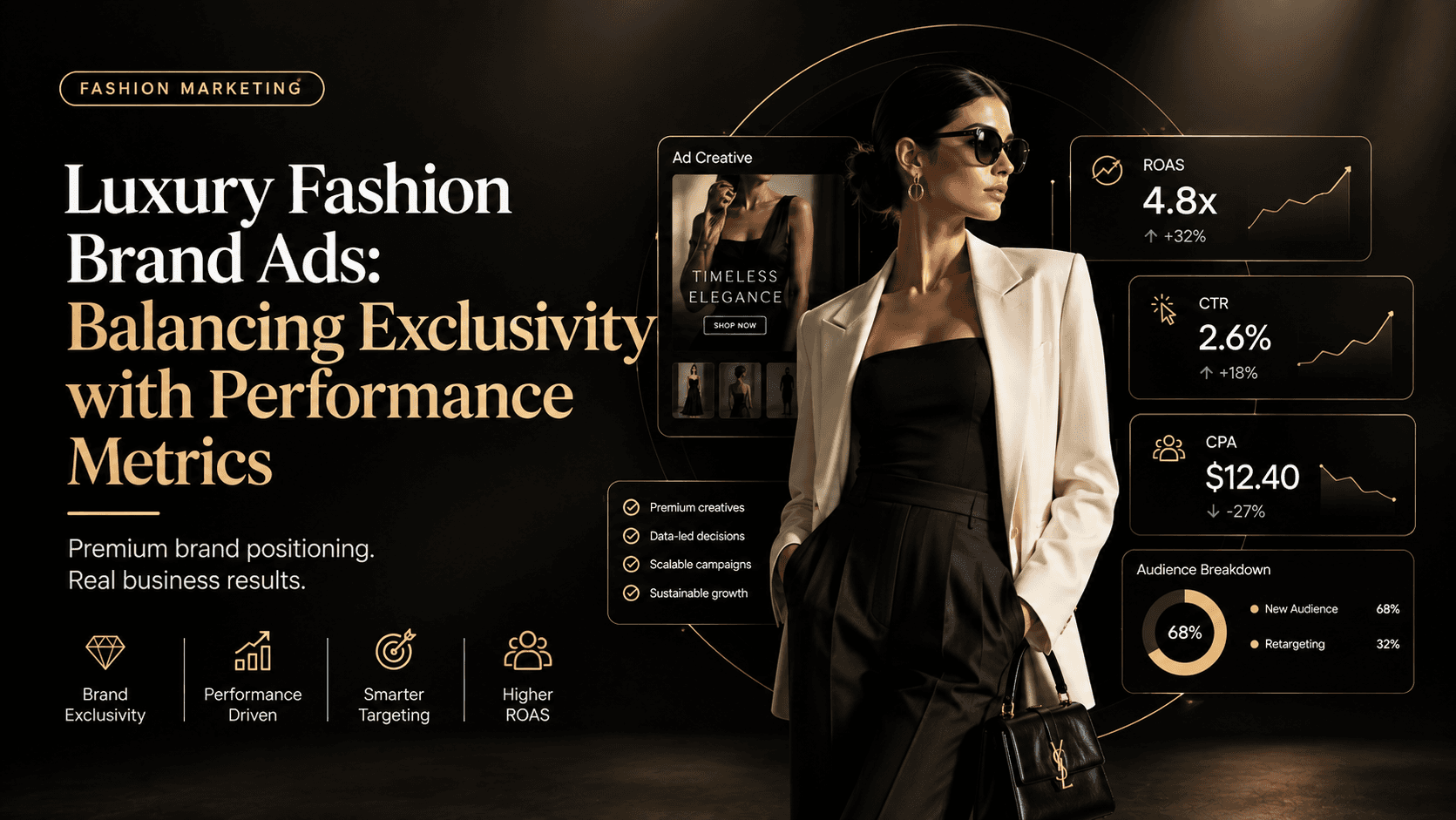
Luxury fashion advertising has a difficult job. It must create desire without looking desperate for the sale, stay selective without becoming invisible, and generate measurable revenue without turning every campaign into a direct-response promotion.
That tension matters more now because luxury consumers are questioning value, overexposure has weakened exclusivity for parts of the sector, and digital discovery keeps expanding beyond traditional brand-controlled channels. For marketers, the challenge is no longer whether luxury fashion brand ads should be measurable. They should. The real question is which metrics deserve weight, and how a brand can improve performance without eroding the signals that justify a premium price.
The strongest approach to luxury ecommerce marketing treats brand equity and conversion efficiency as connected systems. Creative, media buying, merchandising, landing pages, and measurement all need to reinforce the same premium positioning.
Why Luxury Fashion Brand Ads Cannot Be Optimized Like Mass-Market Ecommerce
In mass-market ecommerce, common performance levers include urgency, discounts, price anchoring, aggressive retargeting, and high-frequency promotional creative. These tactics can raise conversion in the short term, but they may be strategically expensive for a luxury label.
Luxury value is partly built through perception: craftsmanship, cultural relevance, scarcity, service, product distinction, and the feeling that access is selective. McKinsey’s 2026 State of Luxury research found that exclusivity is increasingly associated with recognition, access, and experiences that feel earned rather than simply with broad visibility or heritage.
That changes how performance should be evaluated. A lower cost per click is not automatically better if the campaign attracts low-intent traffic. A high click-through rate may be meaningless if promotional language weakens the brand. Even ROAS can mislead when it rewards retargeting existing demand while prospecting, storytelling, and long-term customer quality receive too little credit.
For luxury brands, the objective is not maximum response from everyone. It is profitable response from the right people.
Exclusivity Marketing in Luxury Should Shape the Ad System
Exclusivity marketing luxury strategies do not mean hiding products. They mean controlling the signals around who the product is for, why it deserves attention, and how customers experience access.
Advertising should communicate selectivity through visual language and message hierarchy. Instead of leading every ad with an offer, a luxury fashion brand can lead with a point of view: garment construction, material provenance, a limited collection, an editorial styling moment, or the cultural context behind a design.
This does not eliminate conversion messaging. It changes the sequence.
A useful campaign system separates creative into three roles:
Desire creation: editorial films, collection storytelling, designer perspective, craftsmanship, styling, cultural moments, and brand codes.
Consideration: product details, fit, fabrication, reviews, press validation, creator styling, use cases, and social proof.
Conversion: product-led ads, dynamic retargeting, high-intent search, collection launches, private access, and carefully chosen incentives.
The result is a funnel where performance creative does not need to carry the entire brand story in one frame. Each ad has a commercial job, but all remain recognizably premium.
Creative Testing Without Making the Brand Look Generic
Luxury brands sometimes avoid testing because they associate performance creative with loud hooks, template-heavy UGC, or repetitive product ads. That is a false choice.
A strong performance creative strategy can test variables while protecting art direction. Instead of testing “premium ad versus cheap-looking ad,” test different premium expressions of the same idea.
A brand can test product close-up versus full-look styling, craftsmanship versus occasion-led storytelling, designer voice versus customer voice, model-led editorial versus still life, collection narrative versus hero-product narrative, and soft brand CTA versus direct product CTA.
The testing framework should define non-negotiables before production: typography, color treatment, casting, editing rhythm, product presentation, copy tone, discount rules, and claims. Performance teams then optimize inside those boundaries.
This is where luxury fashion brand ads become scalable. The brand system provides consistency; testing provides learning.
Use Audience Quality, Not Cheap Reach, as the Media Goal
Luxury paid media should not chase low CPMs simply because they make dashboards look efficient. Premium customers may be more expensive to reach, and the most relevant audiences are often smaller than those of mass-market brands.
The better question is whether media is creating qualified attention.
On Meta and TikTok, creative can filter audiences by signaling price point, aesthetic, lifestyle, and product relevance. On Google, branded and high-intent category search can capture shoppers closer to purchase. Pinterest supports visual discovery, while YouTube gives collection films and craftsmanship stories room to build meaning.
A connected paid media advertising strategy matters because luxury customers may discover through one platform, research on another, and purchase later through branded search or direct traffic. Channel-level ROAS alone can miss that journey.
Luxury Brand ROAS: What Should You Actually Measure?
Luxury brand ROAS is useful, but it should sit inside a broader scorecard.
Metric | What It Tells You |
|---|---|
ROAS / MER | Revenue efficiency of paid and total marketing spend |
CAC | Cost of acquiring a new customer |
New-customer revenue share | Whether growth is expanding the customer base |
AOV | Quality and value of transactions |
Contribution margin | Whether sales remain profitable after variable costs |
Repeat purchase / LTV | Whether acquired customers become valuable over time |
Branded search and direct traffic | Whether demand and recognition are strengthening |
Full-price sell-through | Whether growth depends on markdowns |
Return rate | Whether acquisition produces the right customer-product match |
Targets vary by margin structure, category, geography, repeat rate, and business stage. A handbag brand with strong margins may tolerate a different first-order ROAS from seasonal eveningwear with higher return risk.
That is why break-even ROAS should be calculated from real unit economics, not copied from a generic industry benchmark. The business should know how much it can spend to acquire a customer while still protecting contribution margin.
Measure Prospecting and Retargeting Separately
One of the easiest ways to overestimate advertising performance is to combine demand creation with demand capture.
Retargeting usually looks efficient because the customer already knows the brand. Prospecting is harder because it must create enough desire and trust to earn consideration. If both are judged by the same short-term ROAS threshold, teams often cut upper-funnel activity and overfund retargeting.
A better model assigns different expectations by stage. Prospecting can be evaluated using new-customer CAC, qualified sessions, engaged product views, first-time purchaser rate, and assisted revenue. Retargeting can be held to tighter conversion efficiency because it is harvesting warmer demand.
For high-AOV products, attribution windows also deserve scrutiny. Evaluate platform-reported ROAS alongside blended revenue, analytics data, post-purchase surveys, and incremental testing where possible.
Brands selling high-ticket handbags and accessories should also consider how their luxury Meta ad funnel changes between cold discovery, product consideration, and high-intent retargeting rather than forcing every audience into the same campaign logic.
The Landing Page Must Continue the Luxury Experience
Even exceptional ads fail when the click leads to a weak ecommerce experience.
Luxury landing pages and PDPs need to answer high-value purchase questions without feeling cluttered. Customers should quickly understand fabrication, fit, dimensions, craftsmanship, shipping, returns, care, and availability. High-resolution imagery, detail shots, video, styling context, and clear information reduce uncertainty while preserving visual restraint.
This is where conversion rate optimization should support—not fight—the brand. The goal is not to cover a luxury PDP with pop-ups, countdown timers, and oversized promotional banners. It is to remove friction and strengthen confidence.
Better product storytelling, clearer sizing, stronger reassurance, faster mobile UX, and more deliberate image sequencing can improve paid media efficiency without requiring more aggressive advertising.
Be Careful With Discounts: Performance Can Train the Wrong Behavior
Frequent promotions can create a dangerous feedback loop. Discount-led ads often convert quickly, so algorithms send more spend toward people who respond to discounts. The dashboard improves, but the brand may acquire customers who wait for the next markdown.
Instead of defaulting to percentage-off messaging, consider private access, early collection previews, client-only drops, limited editions, complimentary services, selective gifting, or value-added experiences. These mechanisms can create urgency without making price reduction the main reason to buy.
When discounting is commercially necessary, isolate it by audience, season, inventory objective, and duration. Then measure full-price repurchase rate, AOV, margin, customer quality, and whether paid performance falls once the incentive disappears.
A Practical Framework for Balancing Exclusivity and Performance
The best luxury fashion advertising system can be summarized in five principles.
First, define the brand rules before testing. Decide which visual, copy, offer, and customer-experience choices are non-negotiable.
Second, build creative for different funnel roles. Not every ad needs to close the sale; every ad needs a measurable purpose.
Third, optimize for customer quality. Focus on audiences, products, and creative angles that produce profitable new customers.
Fourth, connect ad performance to the site experience. Media, creative, merchandising, and CRO should share the same learning loop.
Fifth, report brand and commercial signals together. ROAS, CAC, margin, and conversion should be reviewed alongside branded demand, full-price sell-through, repeat behavior, and customer quality.
This is also why the distinction between performance creative vs brand creative should not become an internal battle. Luxury brands perform better when both disciplines operate within one strategic system.
Luxury Growth Is Not a Choice Between Brand and Performance
The most effective luxury ecommerce marketing does not choose between desirability and accountability. It designs performance systems that understand what makes the brand desirable in the first place.
Luxury fashion brand ads should still be tested, measured, and optimized. But the optimization target must be bigger than the cheapest click or highest short-term platform ROAS. The goal is to acquire valuable customers, protect premium positioning, and build demand that compounds.
For brands that want to scale without flattening their identity, the advantage comes from connecting luxury fashion marketing, paid media advertising, performance creative strategy, and conversion rate optimization into one operating system.
When exclusivity becomes part of the performance model rather than an obstacle to it, growth can be both measurable and brand-right.
Frequently Asked Questions
1. What makes luxury fashion brand ads different from regular ecommerce ads?
Luxury fashion brand ads focus on more than immediate conversions. They must protect brand perception, exclusivity, craftsmanship, visual identity, and premium pricing while still delivering measurable business results. Unlike mass-market ecommerce campaigns, luxury ads usually avoid excessive discounting, aggressive urgency, and overly promotional creative.
2. How can luxury brands improve ROAS without losing exclusivity?
Improving luxury brand ROAS requires better audience quality, stronger creative testing, high-intent retargeting, improved landing pages, and accurate measurement. Luxury brands should optimize for profitable customers rather than simply chasing the lowest CPC or highest click-through rate.
A strong performance creative strategy can help brands test messaging and formats while maintaining premium visual standards.
3. What is the best advertising strategy for luxury fashion brands?
The best strategy combines brand-building creative with performance marketing. Luxury brands should use editorial storytelling and craftsmanship-focused content for awareness, product education for consideration, and carefully targeted conversion campaigns for high-intent audiences.
A connected paid media advertising strategy can help coordinate Meta, Google, TikTok, YouTube, and other channels across the customer journey.
4. What does exclusivity marketing mean for luxury brands?
Exclusivity marketing luxury strategies focus on creating controlled access, scarcity, premium positioning, and a sense of desirability. This can include limited collections, invitation-only access, early product previews, private client experiences, selective distribution, and premium storytelling.
The goal is not to make a brand inaccessible but to make the customer experience feel distinctive and valuable.
5. Which metrics should luxury fashion brands track?
Luxury fashion brands should track ROAS, CAC, customer lifetime value, average order value, contribution margin, new-customer revenue, repeat purchase rate, branded search demand, full-price sell-through, and return rate.
Looking at multiple metrics gives a more accurate picture than relying only on platform-reported ROAS.
6. Is ROAS the most important metric for luxury ecommerce marketing?
No. ROAS is important, but it should not be the only measure of success in luxury ecommerce marketing.
A campaign may produce a strong short-term ROAS by retargeting existing customers, while doing little to create new demand. Luxury brands should also evaluate new-customer CAC, margins, repeat purchases, customer quality, and long-term brand demand.
Featured Case Study

304 %
Scaled Revenue MoM

4x ROAS
consistently over 6 months

125 %
YoY Meta Spend Growth

304 %
Scaled Revenue MoM
OUR APPROACH
Turning Performance Data
Into Profit Clarity
1. Profit-First Measurement
We start where most growth strategies stop: profit. Campaigns, channels, and products are evaluated against margin, contribution, and cash flow—not surface metrics.
2. Marketing Connected to the P&L
Performance data only matters when it maps to financial reality. We align ad spend, customer acquisition, inventory, and lifecycle value into a single decision-making system.
3. Continuous Financial Optimization
Growth isn’t a one-time model. We monitor performance as conditions change—traffic mix, demand, costs—so decisions stay profitable as you scale.




Want to get similar results?
Our Impact,
By The Numbers
RELATED ARTICLES