ARTICLES
Category:
Industry Specific Strategy

Fashion brands don't plateau at 8 figures because demand runs out. They plateau because the system that got them there — a few brilliant ads, a founder's instinct, one great agency relationship — is a craft system, and somewhere past $10M the game quietly becomes an industrial one. The brands that break through swap heroics for throughput. The ones that don't spend two years buying back the same revenue at rising CAC.
The three signatures of a plateau (you'll recognize at least two)
Working across 50+ fashion and DTC brands, we see the same tells in the first account audit — usually before anyone opens a spreadsheet, because the team describes them unprompted. One: the museum of winners — the top five spenders in the ad account are months old, still converting, still decaying a little every week, and everyone is quietly afraid to touch them. Two: CAC that rises with every budget increase, which the team explains as "auction costs" or "iOS" when it's mostly fatigue wearing a macro costume. Three: the discount drip — top-line growth propped up by promotions that contribution margin quietly pays for, visible only when someone charts promo share of revenue across four quarters and watches it climb. None of these means anything is broken. They mean the brand has outgrown its creative supply chain, which is a success problem — but an expensive one to ignore. (Brands that fail outright do so for different reasons — we've written about those separately.)
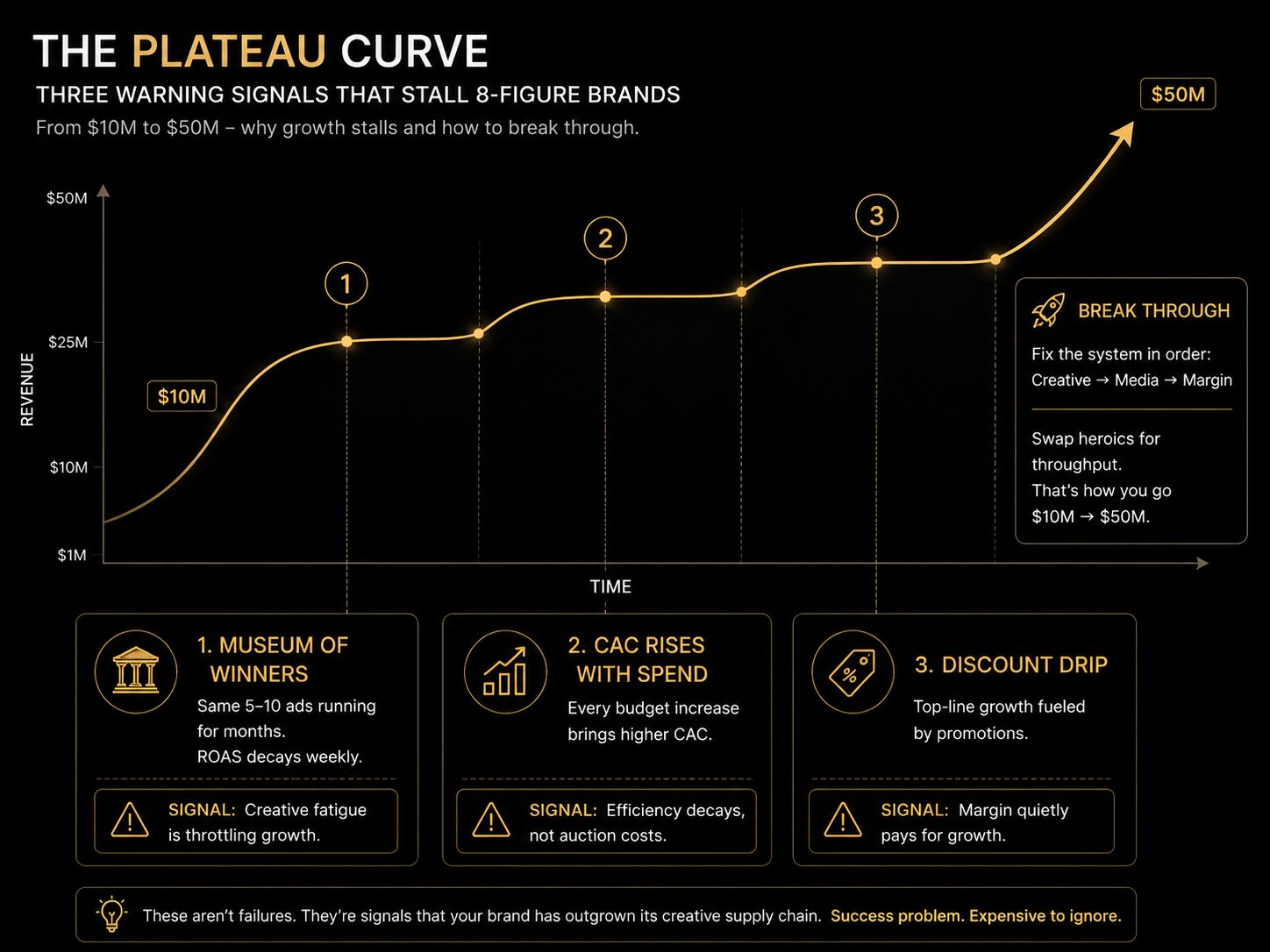
Run the three checks before you believe me
Each signature has a five-minute test. The museum check: in Ads Manager, sort active ads by spend descending and read the launch dates on the top five — over eight weeks old and still carrying the account means your winners are aging assets, not a pipeline. The efficiency check: export weekly spend and weekly CAC for the last two quarters and put them on one chart; if they rise together, budget increases are buying inflation, not growth. The margin check: ask finance what share of the last quarter's revenue shipped under any promotion, and compare it to a year ago; a rising promo share with flat revenue is the discount drip in progress. Most plateaued brands fail two of three. All three, and the plateau is already eating cash.
The founder bottleneck nobody names
There's a fourth signature, awkward to say out loud: at eight figures, the founder is usually still the creative approval gate. Every ad waits for one person's eye — the same eye whose taste built the brand, which is exactly why nobody challenges the queue. But a weekly testing cadence cannot wait for a founder's Thursday, and so the system quietly throttles itself to the speed of one calendar. The fix is not removing the founder's taste; it's codifying it — casting, color, tone, retouch standards written down as guardrails — so approval moves from a person to a system the person authored. Founders who make that trade get their weeks back and, counterintuitively, tighter brand consistency, because a written standard argues less than a tired one.

Why "spend more" is the trap
At plateau, media budget is the only lever most teams can pull quickly, so they pull it. But delivery systems price incremental reach progressively higher, and they price stale creative higher still — so every added dollar buys colder audiences with more tired ads. The result is the plateau's signature math: +30% spend, +10% revenue, margin absorbing the difference. The pattern has an autopsy that repeats across accounts: the budget increase ships on a Monday, delivery expands into colder audiences by Wednesday, the platform re-prices reach upward through the week, and the fatigued creative slate converts the new traffic a notch worse than the old — so by month's end the team is explaining a CAC increase to a founder who just approved more money. Run that cycle three times and the organization concludes that "paid is maxed out," which is almost never true. What's maxed out is the creative's ability to earn attention from people who haven't already seen it. The lever that actually moves is creative throughput: more distinct hypotheses about why people buy, tested weekly, killed or scaled without sentiment. We've watched this single change reprice entire accounts — for MPG Sport it meant a sustained 5X+ monthly ROAS with CAC down 70% (the case study), and across our portfolio the same system has cut CAC by 227% brands' first quarter in.
The creative system that breaks through
Four parts, none optional. Concept engine: a weekly pipeline of ideas sourced from customer language, not moodboards — reviews, support tickets, DMs, and the objections sales hears are a permanently refilling brief, and the accounts that mine them never run out of hypotheses. Modular production: shoot days designed to yield 20+ cuts, which is how 2,500+ ads a month get made across our portfolio without 2,500 shoots — the shot list is written by the concept matrix, not the other way around. Testing discipline: every concept enters with a kill/scale rule attached and a minimum learn-window before judgment; no zombie ads, and no executions killed on day two by someone's mood. Brand guardrails in writing: codes, casting, tone, and retouch standards documented so volume never becomes drift — this is what lets luxury brands run performance cadence without cheapening anything. It's the system behind our performance creative practice, and the full operating model — including the media and margin engines around it — is in the $10M→$50M pillar.
What breaking through actually looks like
It's undramatic. Weekly creative readouts replace quarterly campaign reveals. The ad account's average creative age drops from months to weeks. CAC stops responding to spend increases with immediate punishment — the first budget lift that doesn't spike CAC is usually the moment the founder believes the system. Six months in, the account looks structurally different: spend spread across fifteen-plus live concepts instead of five, no single ad carrying more than a modest share of budget, a learning log that says which hypotheses won and why, and a media plan that survives the death of any individual winner because the pipeline replaces it inside a week. Finance starts attending the marketing meeting because contribution margin — up 300% across our portfolio when the full system lands — finally moves in the same direction as revenue. The 57-day average break-even we benchmark across clients isn't a vanity stat; it's what lets a brand fund its own next plateau instead of financing it. See the pattern across brands on our results page.
The operating rhythm underneath is simple enough to fit in a sentence each. Monday: one scoreboard — spend, blended MER, contribution margin, average creative age, break-even days — read in fifteen minutes by marketing and finance together. Wednesday: the concept brief, written from customer language and last week's data, enters production. Friday: every live concept gets a kill, scale, or hold decision, logged with a reason. Monthly, the brand guardrails get reviewed and the 10% wildcard bets get chosen; quarterly, the cohort model gets rebuilt with finance. None of it is clever. All of it is the difference between a brand that reacts to its plateau and a brand that runs a system the plateau can't survive. The founders who've made the switch describe the same feeling: growth stopped being a mystery and became a queue.
FAQs
Is a revenue plateau always a marketing problem?
No — assortment gaps, inventory constraints, and channel mix plateau brands too, and no creative system fixes a product people don't want twice. But when revenue flattens while ad spend rises and the product sells well organically, the constraint is almost always creative supply and media structure — and those two are testable within a quarter, which is why we start there.
How long does it take to break a plateau?
Accounts typically show direction inside 6–8 weeks of running weekly creative testing; durable CAC improvement usually lands within a quarter — our portfolio's 440% ROAS improvements came within three months.
Can this be done in-house?
Yes, with senior creative leadership, production capacity, and testing discipline. Most 8-figure brands buy the system before they build it — either path works if the cadence holds.
How do I know it's a plateau and not a market ceiling?
A ceiling shows up everywhere at once: organic, retention, and paid all flatten together, and category demand is visibly saturated. A plateau shows up in paid first while organic demand and repeat behavior stay healthy — the brand is wanted, the machine converting that want has stalled. Fashion brands hit real ceilings far later than founders fear; we've yet to audit an 8-figure account where the constraint wasn't the machine.
Featured Case Study


304 %
Scaled Revenue MoM


4x ROAS
consistently over 6 months


125 %
YoY Meta Spend Growth


304 %
Scaled Revenue MoM
OUR APPROACH
Turning Performance Data
Into Profit Clarity
1. Profit-First Measurement
We start where most growth strategies stop: profit. Campaigns, channels, and products are evaluated against margin, contribution, and cash flow—not surface metrics.
2. Marketing Connected to the P&L
Performance data only matters when it maps to financial reality. We align ad spend, customer acquisition, inventory, and lifecycle value into a single decision-making system.
3. Continuous Financial Optimization
Growth isn’t a one-time model. We monitor performance as conditions change—traffic mix, demand, costs—so decisions stay profitable as you scale.




Want to get similar results?
Our Impact,
By The Numbers
RELATED ARTICLES