ARTICLES
Category:
Paid Ads Strategy

Luxury accessory brands have a complicated relationship with Meta. The platform offers unmatched reach, precise targeting, and a visual-first format that should, in theory, be perfect for showcasing craftsmanship and design. Yet many premium brands still hesitate, worried that running ads on the same feed as fast-fashion flash sales will make their product feel less exclusive.
That fear is understandable, but it's based on an outdated assumption. The problem was never Meta itself it's how brands use it. Done right, luxury accessories Meta ads can build desire, drive qualified traffic, and protect brand equity at the same time. Done poorly, they can absolutely make a $2,000 handbag look like it belongs in a clearance bin.
This guide breaks down what separates the two outcomes: the creative principles, targeting discipline, funnel structure, and measurement approach that let premium brands scale on Meta without sacrificing the perception that makes them premium in the first place.
Why Luxury Brands Are Wary of Meta Advertising
Before diving into tactics, it's worth understanding where the hesitation comes from because the concern isn't irrational.
The Perception Risk of Mass-Market Ad Formats
Meta's ad ecosystem was built around direct response: carousel ads with bold discount badges, countdown timers, and Shop Now urgency. These formats work well for impulse-driven categories, but luxury buyers respond to a different set of cues. They're drawn to scarcity, craftsmanship, and narrative and not flashing percentages off. When a premium accessories brand borrows the visual language of mass-market ecommerce, it signals the wrong thing to the exact audience it's trying to attract.
There's also a subtler risk: algorithmic ad delivery doesn't inherently understand brand tone. Left unchecked, it will often favor whichever creative gets the fastest click, which tends to reward louder, more promotional executions. The opposite of what luxury branding usually calls for.
The Cost of Staying Off Meta Entirely
At the same time, opting out of paid social entirely has a real cost. Competitors are already running polished luxury brand paid ads that capture high-intent shoppers scrolling through their feed. Staying off the platform means giving up:
Access to warm-audience retargeting for people who've already visited the site
The ability to reach lookalike audiences modeled on your best existing customers
A high-impact video format for storytelling that static banners and print simply can't replicate
First-touch discovery among affluent shoppers who increasingly research luxury purchases on social before buying
The real issue is its execution. Brands that get this right treat Meta less like a discount channel and more like a digital storefront window.
What Makes Luxury Accessories Meta Ads Different From Regular Ecommerce Ads
Not all Meta advertising looks the same, and that's the point. Luxury accessories Meta ads need a distinct visual and copy approach compared to standard ecommerce campaigns.
Visual Standards
The photography and video direction should feel closer to an editorial spread than a product catalog. That means product-in-context shots, lifestyle framing, and pacing that lingers rather than rushes to a call to action.
Element | Mass-Market Ecommerce Ads | Luxury Accessories Meta Ads |
CTA tone | Shop Now, Buy Today | Discover, Explore the Collection |
Offer framing | Percentage discounts, flash sales | Limited availability, seasonal drops |
Visual pacing | Fast cuts, multiple products per frame | Slower cuts, single hero product |
Copy length | Short, urgency-driven | Longer, story-driven |
Audience signal | Broad, price-sensitive | Narrow, aspiration-driven |
Copywriting That Sells Without Sounding Salesy
The words matter as much as the visuals. Avoid % off, limited time, and other discount-driven phrasing that immediately signals a markdown mentality. Instead:
Lead with heritage or craftsmanship details (materials, construction, provenance)
Use sensory, descriptive language rather than transactional language
Frame urgency around exclusivity (while the collection lasts) rather than price
Keep the call to action understated invitation, not a command
Building a Premium Ecommerce Ads Funnel Without Discounting the Brand
A funnel built for premium ecommerce ads looks different at every stage than one built for a mass-market brand chasing volume.
Top-of-Funnel:
Early-stage creative should introduce the brand's world before asking for a sale. Founder narratives, behind-the-scenes craftsmanship footage, and short brand films perform better here than direct-response hooks, because they build the emotional context luxury buyers expect before they'll even consider clicking through.
Mid-Funnel:
Retargeting is where many luxury brands lose credibility fastest. Showing the same ad five times a day with an increasingly aggressive discount is a fast way to erode perceived value. Instead, cap frequency, rotate creative between UGC, testimonials, and styling content, and let the retargeting sequence feel like a continuation of the brand story rather than a repeated sales pitch.
Bottom-of-Funnel:
At the point of conversion, luxury brands benefit from treating the moment as an invitation rather than a push. Personalized shopping links, private sale framing, or early-access offers to a loyalty segment tend to convert better than blanket coupon codes and they reinforce exclusivity rather than undercutting it. This is where premium ecommerce ads succeed by making the customer feel selected, not sold to.
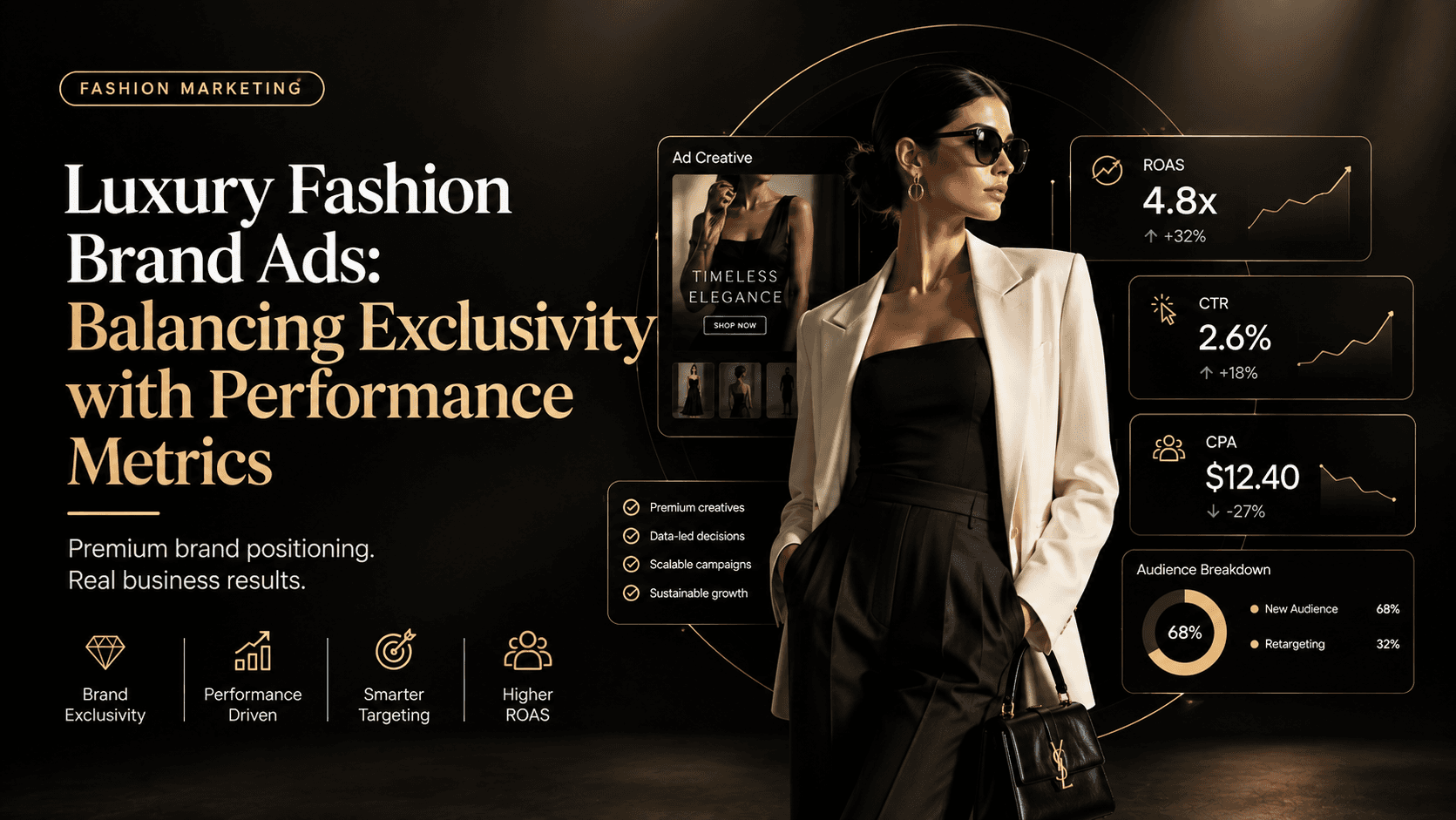
For a closer look at how exclusivity and performance metrics can coexist without one undermining the other, this piece on balancing exclusivity with performance metrics in luxury fashion ads breaks down the tension in more detail.
Crafting a Luxury Accessories Marketing Strategy That Scales on Meta
Getting the creative and funnel right is only part of the equation. Scaling requires a luxury accessories marketing strategy that holds up under increased spend without forcing shortcuts.
Audience Targeting
Rather than chasing the broadest possible audience, luxury brands typically get better results from narrower, more deliberate targeting: lookalike audiences built from high-lifetime-value customers, interest layering around fashion publications or events, and geographic or income-based filters that align with the brand's actual buyer profile. Precision protects both budget efficiency and brand fit.
Budget Pacing
Aggressive budget spikes often force brands into promotional shortcuts just to hit spend targets, which is how discount-driven messaging creeps in. A more sustainable approach tests creative and audiences on a smaller budget first, then scales what's proven protecting margins while still gathering the data needed to grow spend responsibly.
Creative Testing Without Breaking Brand Guidelines
Testing shouldn't mean abandoning visual consistency. Brands can still run structured tests while keeping identity locked:
Compare static imagery against short-form video and Reels
Test copy length and tone variations within approved brand voice
Rotate hero products without changing lighting, color grading, or framing style
Isolate one variable per test to keep learnings clean
Brands scaling performance creative while protecting design consistency often lean on a dedicated performance creative strategy partner to manage this balance at scale, since creative testing ad volume and brand oversight can pull in opposite directions without a clear process.
Common Mistakes That Cheapen Luxury Brands on Meta
Even well-intentioned campaigns can undercut brand equity through avoidable missteps. Watch for these:
Over-reliance on discount codes in ad copy which trains the audience to wait for a markdown instead of valuing full-price purchases
Using stock-style UGC that clashes with the brand's established visual identity
Ignoring landing page consistency so a polished ad leads to a page that feels like a different, less premium brand
Chasing vanity metrics like click-through rate instead of tracking average order value and lifetime value
Retargeting fatigue from showing the same ad too frequently, which feels less like storytelling and more like harassment
Inconsistent tone across formats where Stories, Reels, and feed ads each speak in a slightly different voice
Landing page mismatch in particular is one of the fastest ways to lose credibility after the click. This breakdown of how evening wear brands reduce return rates through better landing page UX offers a useful parallel for accessory brands facing the same post-click drop-off.
How to Measure Success Without Sacrificing Brand Equity
Measurement is where a lot of luxury brands get pulled off course, chasing the same short-term metrics that mass-market advertisers optimize for.
Return on ad spend still matters, but it shouldn't be the only lens. Average order value, repeat purchase rate, brand search lift, and the ratio of new-to-returning customer revenue all paint a fuller picture of whether luxury accessories Meta ads are building long-term brand value or just generating short-term transactions.
If repeat purchase rate and AOV are climbing alongside spend, that's a signal the brand can scale further without diluting positioning. If CTR is rising but AOV is falling, or if the audience mix is skewing toward heavily discount-motivated buyers, that's usually a sign to pull back and re-anchor the creative and targeting before increasing budget again.
Partnering With the Right Team to Run Luxury Accessories Meta Ads
Executing everything above editorial creative, disciplined targeting, restrained retargeting, and equity-focused measurement. It is resource-intensive, and it's why many premium accessory brands choose to work with a specialized partner rather than build this in-house from scratch.
Veicolo works specifically with fashion, accessories, and consumer brands navigating this exact challenge: how to scale profitably on Meta without compromising the brand experience that makes a product worth a premium price. The agency's category experience spans luxury accessories, handbags, and jewelry, with client results including significant ROAS improvement and CAC reduction achieved without leaning on discount-driven tactics.
For brands exploring how to structure this properly, a few relevant starting points include:
Paid Media Advertising Services for campaign strategy and management
Performance Creative Strategy for creative that tests well without breaking brand guidelines
Landing Page & Funnel Optimization for ensuring the post-click experience matches the ad's premium tone
Brands running luxury brand paid ads at scale often find that the difference between a campaign that builds prestige and one that erodes it comes down to this kind of disciplined execution.
Conclusion
Luxury accessories Meta ads work when every layer like creative, targeting, funnel design, and measurement . It is built to protect brand equity rather than chase short-term clicks. The brands that succeed on Meta aren't the ones shouting the loudest; they're the ones translating their in-store exclusivity into a scroll-stopping, story-driven digital experience.
A disciplined luxury accessories marketing strategy turns Meta into a prestige-building channel instead of a discount channel, and the same principles that apply to premium ecommerce ads in general become even more important when the product itself is positioned at the top of the market. Get the fundamentals right, and Meta becomes one of the most effective tools a luxury accessories brand has for reaching the right customer without ever looking like it's trying too hard.
FAQs
Can luxury accessory brands run Meta ads without looking discount-driven?
Yes, by prioritizing editorial creative, restrained copy, and VIP-style offers over coupon codes, brands maintain prestige while still using Meta's targeting and reach.
What ad format works best for premium ecommerce ads?
Short-form video and Reels showing craftsmanship or lifestyle context typically outperform static product-only ads, since luxury buyers respond to storytelling over direct promotion.
How often should luxury brands change their Meta creative?
Every 2-3 weeks for prospecting campaigns; less frequently for brand-building content, which can run longer without feeling repetitive to a curated audience.
Does retargeting hurt a luxury brand's perceived exclusivity?
Only when overused. Capped frequency, personalized messaging, and sequenced storytelling keep retargeting feeling like an invitation rather than a pushy discount reminder.
Is Meta advertising worth it for high-ticket accessory brands?
Yes, when paired with strong creative and funnel discipline. Meta's targeting precision helps luxury accessories meta ads reach high-intent buyers without relying on blanket discounting.
Featured Case Study


304 %
Scaled Revenue MoM

4x ROAS
consistently over 6 months

125 %
YoY Meta Spend Growth


304 %
Scaled Revenue MoM
OUR APPROACH
Turning Performance Data
Into Profit Clarity
1. Profit-First Measurement
We start where most growth strategies stop: profit. Campaigns, channels, and products are evaluated against margin, contribution, and cash flow—not surface metrics.
2. Marketing Connected to the P&L
Performance data only matters when it maps to financial reality. We align ad spend, customer acquisition, inventory, and lifecycle value into a single decision-making system.
3. Continuous Financial Optimization
Growth isn’t a one-time model. We monitor performance as conditions change—traffic mix, demand, costs—so decisions stay profitable as you scale.




Want to get similar results?
Our Impact,
By The Numbers
RELATED ARTICLES